
God’s Word is Our Guide for Life
God’s word guides us through all of life’s circumstances: 1) Affliction, 2) Worship, 3) Decisions, 4) Persecution, and 5) The Future. Each hearer should know that they can trust in God’s word to guide them.


God’s word guides us through all of life’s circumstances: 1) Affliction, 2) Worship, 3) Decisions, 4) Persecution, and 5) The Future. Each hearer should know that they can trust in God’s word to guide them.

In this lesson, we will look at some of Paul’s methods of evangelism. Each listener should be able to learn from Paul’s example of evangelism. I hope that we will follow Paul’s example and be more evangelistic.

In this lesson we will study through Revelation 12 and note how the dragon fails: 1) To Destroy the Messiah, 2) To Take Over Heaven, 3) To Conquer God’s People. Each hearer should be encouraged that Satan cannot conquer us as long as we remain in Christ.

The Christian can truly have personal peace in his life by following some practical instructions from scripture. Each hearer should know how to have personal peace in his life. This lesson brings scripture to bear on some practical ways to have personal peace.
Let’s remember that we are to love Him with all of our heart, soul, and mind (Matthew 22:37). Let’s remember to bring up our children in the nurture and admonition of the Lord (Ephesians 6:4). Let’s remember to seek first God’s kingdom and His righteousness, and then everything that we need will be provided to us by Him (Matthew 6:33).

We will look at the parable and then draw out some principles. We need to take care of God’s people as Jesus desires, not as we desire.

Jesus died on the cross to redeem mankind 1) with a cost, 2) from condemnation, 3) to communion, and 4) for consecration. Each hearer should understand the deeper meaning of redemption as relates to Christ’s sacrifice.
In Psalm 24:1 we have the basic principle that God owns everything and everybody: “The earth is the Lord’s, and all its fullness, The world and those who dwell therein.” The apostle Paul quotes this Psalm in 1 Corinthians 10:26, 28 further emphasizing the truth.

After studying the issue, I am personally inclined to understand the number as one male and one female of the unclean and then four males and three females of the clean as well as the fowls. Economy of space within the ark would also support this conclusion.
Paul does not say there was no law in the day of Abraham or even before that. That is not his point at all. He merely says that where there is no law then there is no transgression. What then is the point? His point is that when God gave the promise to Abraham, that promise was given without law. Hence that promise was made to Abraham upon the condition of faith, not upon the condition of law.
This lesson will discuss how God defines the relationship of people to their labor. Each hearer should understand that labor is good, but it does not define us.
Work cannot satisfy our desire to be someone, only God can. Without Him, labor has no meaning.

A narcissist, who is also passive aggressive, will rarely ever confront someone directly because he does not want to change and take ownership of his problems; it is much easier to blame others.
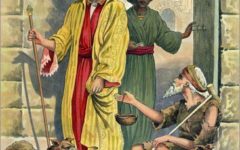
In this lesson we will study the story of the rich man and Lazarus and notice: 1) The characters, 2) The circumstances, 3) The cries of the rich man, 4) The conclusions of the story. Each listener should be able to understand the story, repeat it, and explain it. I hope to to familiarize everyone with this story and teach its lessons so as not to fall into similar circumstances as the rich man.
Discontentment is a lack of faith. In 1 Timothy 6:17 Paul writes, “Command those who are rich in this present age not to be haughty, nor to trust in uncertain riches but in the living God, who gives us richly all things to enjoy.” God is the greatest giver and He gives richly all things to enjoy; let’s be content with Him.

In the Old Testament, God makes provision for His people to rest. The Jews did not work on the Sabbath day; they were required by God to rest. Exodus 20:8-10 states, “Remember the Sabbath day, to keep it holy…. In it you shall do no work….”

Jesus died on the cross because God loved the world enough to sacrifice His own Son for the world’s salvation. Each listener should be able to explain how God’s love motivated Him to sacrifice His Son, Jesus. Jesus died on the cross because 1) God is a God of Love, 2) The World Needed True Love, 3) The Son Demonstrated that Love. I hope that the listener would understand God’s motives in sending His Son to die on the cross.