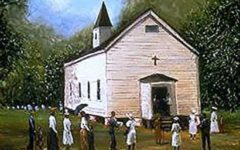
In 1 Corinthians 12-14, the apostle Paul addresses the abuse of miracles in the worship assembly. He concludes that section of teaching with this admonition: “Let all things be done decently and in order” (1 Corinthians 14:40).
We want you and all your friends and family to come to our gospel meeting beginning next week with Chris Hooten! This coming Saturday, we will be having our stew supper, and that will be an opportunity for you to get to meet Chris and know him a bit better.
In this lesson, we will discuss the conversion of the three thousand in Acts chapter 2 and the essential ingredients to effective evangelism. This includes 1) The Presence of the Holy Spirit, 2) People of the Dispersion, 3) Prophets of the Old Testament, 4) Preachers of the Gospel, 5) Penitent of Heart, 6) Persistent in Faithfulness. The hearer should be familiar with the events in Acts 2 and the principles of evangelism as related to this conversion account. The aim of this lesson is to help the hearer understand more about the principles of evangelism taught in Acts 2.
In this sermon we will examine the statement, "To The Blind He Gives Sight." He does this because there is, 1) A Need--the blind need to see, 2) A Name--only He has this authority, 3) A Notion--the blind who see will tell others, 4) A Nation--the blind who see will believe and worship together, and 5) A Night--an eternal blindness is coming for those who do not see. I want to impress upon each hearer that God wants all men to be saved and to come to the truth and to help the congregation become more evangelistic.
In Revelation 16, God's righteous judgment falls on those who worship the beast. All will be judged by Christ's words (John 12:48), so let's live for Him.
Why is communion important? It is a 1) Declaration of Faith, 2) Demonstration of Fellowship, 3) Deliberation of Forgiveness. The listener should understand the importance of communion in relationship to Christ, others, and himself.
When we have a right attitude toward God, we will 1) Fear God, 2) Worship God, 3) Love God. The hearer should have a fundamental idea of what it means to be godly: have a right attitude toward God.
In this lesson we will examine how we got the Bible. We will briefly look at the canonization, the transmission, and the translation of the text. The student should be able to briefly discuss the concepts of canonization, transmission and translation. The aim of this lesson is to help all understand that the Bible has been accurately preserved throughout the ages for our benefit and that we have what they had.
Why remember Jesus (Luke 22:14-20)? 1) It Is the Apostles' Doctrine, 2) Grateful Hearts Remember, 3) The Father Wants It. Each person should remember Him weekly.
Psalm 119:1-8, the behavior of the blessed: 1) Blessed Conduct, 2) Binding Commands, 3) Bona Fide Commitment. Each person should become more familiar with Psalm 119.
For Christ and the church let us 1) Praise Lovingly, 2) Pray Fervently, 3) Give Willingly, 4) Serve Faithfully. That each considers the words to this great song and be renewed in spirit in these great actions of which the song exhorts us to do. To enhance our understanding of this hymn and also encourage each to faithfulness in these areas.
Bible study is worship (Psalm 1:1-3): 1) Reciting God's Will, 2) Respecting His Word, 3) Retaining His Thoughts, 4) Retooling Our Lives. Each person worships in study.
Prayer is worship (Matthew 6:9-13): 1) Ascribing Glory to God, 2) Acknowledging Dependence, 3) Asking for Needs, 4) Accepting Blessings. Each person should pray so.
Worshiping God in song (Colossians 3:15-17) involves 1) Beauty, 2) Doctrine, 3) Comprehension, 4) Attitude. Each person should understand proper worship in singing.
Before God's throne (Revelation 4:1-11) 1) Beauty Is Defined, 2) God Is Exalted, 3) Holiness Is Honored, 4) Man Is Humbled, and more. Each person should enter it in awe.
Why no instruments in worship? The New Testament church sang (Ephesians 5:19, Colossians 3:16), and we want to be like them. Faith comes by hearing God's word.