Why should I be involved in personal evangelism? 1) Love 2) Thankfulness 3) Joy. Each should understand these motives for personal evangelism. The aim of this sermon is to motivate the brethren to get involved in personal evangelism.
In this sermon we will examine the statement, "To The Blind He Gives Sight." He does this because there is, 1) A Need--the blind need to see, 2) A Name--only He has this authority, 3) A Notion--the blind who see will tell others, 4) A Nation--the blind who see will believe and worship together, and 5) A Night--an eternal blindness is coming for those who do not see. I want to impress upon each hearer that God wants all men to be saved and to come to the truth and to help the congregation become more evangelistic.
In this lesson we will learn that the life is in the blood as we compare the functions of blood with the functions of the blood of Christ: Blood 1) replenishes, 2) removes, 3) repairs, and 4) regulates. Each listener should recognize the function of the blood of Christ as it gives life to the body.
If I were a rich man, I would recognize, 1) my relationship with God regarding wealth, 2) the reasons God has given for wealth, 3) the problems associated with wealth. The hearer should be able to understand their responsibilities and attitudes toward wealth. I want everyone to have a proper, healthy, and reverent attitude toward the teaching within God's word regarding wealth.
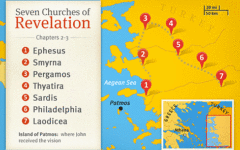
To the church of Philadelphia we have a message of 1) Opportunity, 2) Conquering, 3) Help in the time of need, and 4) Steadfastness. We should all be familiar with this letter and gain great encouragement from knowing that God continues to instruct and warn even when we are faithful.
Jesus is King of my life (1 Timothy 6:13-16) because 1) He Is My God, 2) He Is My Savior, 3) He Is My All. Each person should be able to state why Jesus is their King.
We wrestle with God too. What does it mean to wrestle with God, and how do we win?: 1) We wrestle with God when we seek to impose our will on others and God. 2) We wrestle with God and He with us through life’s troubles. 3) We can win our wrestling match with God by humbling ourselves and trusting in Him. Wresting with God is a good thing if we learn to humble ourselves and trust in God.
The book of First Corinthians contrasts the wisdom of men with the wisdom of God on the following topics: 1) Unity vs. Division, 2) Morality vs. Immorality, 3) God’s Glory vs. Idolatry, 4) Orderliness vs. Disorderliness, 5) Resurrection vs. No Resurrection. Each listener should understand that God’s wisdom is greater than man’s wisdom and desire to follow God’s wisdom.
Why is communion important? It is a 1) Declaration of Faith, 2) Demonstration of Fellowship, 3) Deliberation of Forgiveness. The listener should understand the importance of communion in relationship to Christ, others, and himself.
Fear comes from 1) Lack of Knowledge, 2) Lack of Love, and 3) Lack of Faith. That we may be able to overcome our fears and live in love, peace, and fellowship with one another.
When we have a right attitude toward God, we will 1) Fear God, 2) Worship God, 3) Love God. The hearer should have a fundamental idea of what it means to be godly: have a right attitude toward God.
As Christians, we can celebrate our independence by 1) Praying, 2) Obeying, and 3) Honoring our government. Each Christian should understand that he can be a good citizen under any government by doing the above activities.
In this lesson we will look at the church in Sardis as described in Revelation 3. Each should be familiar with the description of the church at Sardis. The aim of this lesson is to teach the lessons of the church at Sardis.
God’s word provides for us in the time of our afflictions. It teaches us that 1) God is good; 2) Afflictions Refine the Righteous, 3) The wicked will not comfort us. Each hearer should understand that in times of distress we need to go to God and his word for comfort, peace, and help.
The Bible teaches about anger: 1) Righteous vs. Unrighteous Anger, 2) The Victims of Anger, 3) Anger Generates Hatred, 4) We can do something about it! Each listener should be resolved to know what anger is, does, and how to take action to deal with it.
In this lesson we will see that to engage in evangelism is 1) Loving God, 2) Loving Your Neighbor, and 3) Loving Yourself as God Loves You. Each person should understand that to love our friends and family as God wants us to love them, we must engage in personal evangelism.
In this lesson, we will examine David’s practice of grace to Saul’s house. David understood that: 1) Grace was a Desire, 2) Grace was Proactive, 3) Grace Restores, 4) Grace Gives. Each person should learn what it means to be gracious to others and resolve to practice more grace in our lives.
Hope is important because it gives us something 1) To Talk About, 2) To Work Toward, 3) To Hang Onto. Each should understand the importance of hope in the life of the Christian.
In Hebrews 1 we learn that Jesus is God due to His 1) Authority as God, 2) Identity as God, 3) Relationship to the Creation as God, 4) Superiority over the angels as God. We want to understand that because Jesus is God, he can be the perfect high priestly mediator between God and man. The aim of this lesson is to understand who Jesus really is in relationship to all things.