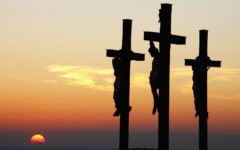


Tag: Crucified

  • bible-questions

    Why Did Paul Say He Didn’t Come to Baptize?

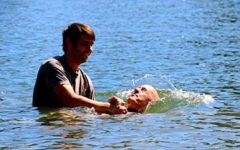
    We note that Paul's statement that Christ sent him not to baptize, didn't mean that Paul never baptized anyone. If it was the case that Paul wasn't supposed to baptize anyone, then he wouldn't have baptized Crispus and Gaius who he directly states in the context that he did indeed baptize. So the passage couldn't mean that Christ didn't send Paul to baptize at all.

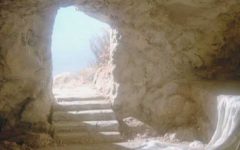
  • Repent and Turn to God

    To obey the command to repent we must 1) Believe God’s Analysis of Our Condition, 2) Change Our Mind and Attitude, 3) Change our Behavior. Each member should be able to explain what this command means and how to perform it. My aim in this lesson is to encourage in the heart of each person the desire to live a life of repentance.

  • resurrection

    Jesus and the Resurrection

    Jesus and the Resurrection show that 1) He is my God. 2) He is my Savior. 3) He is my All! Each person should be able to state why Jesus and the Resurrection is relevant. The aim of this lesson is to teach the deity of Jesus and emphasize his sovereignty over our lives.

  • baptism

    What Must I Do to be Saved?

    In this lesson we will study the question, “What must I do to be saved?” In the scriptures this question was asked three times and we will study each of these circumstances and the answer to the question in each of these circumstances understanding this: that if the same question is asked today, it should be answered in the same way. The hearer should be able to know where these passage are and be able to use them to answer the same question for those who ask in the world today. The aim of this lesson is to empower each individual Christian to be able to answer this most critical question.

  • The Extreme Jesus

    In this lesson we will examine the Extreme Jesus. When we look at the Extreme Jesus, we find 1) Extreme measure to deal with sin, 2) Extreme dedication required of his disciples, 3) Extreme righteousness, and 4) Extreme love. The objective is that each individual Christian would get to know the extreme Jesus in their life.

  • Who is Jesus? (John 3:16)

    In this lesson, we will focus on John 3:16 as we seek to answer the question, “Who is Jesus?” Jesus is 1) the Son of God, 2) the Savior, and 3) the Personification of Grace and Truth. This lesson seeks to provide a basic answer to the question who is Jesus for those who are seeking rudimentary knowledge.

  • darkness

    How much darkness was at Jesus’ crucifixion?

    “Now from the sixth hour until the ninth hour there was darkness over all the land” (Matthew 27:45). The Greek word for “darkness” in this verse is skotos. There is nothing especially significant about the word indicating the quality of darkness. The word may be used to talk about a pitch black darkness such as in Tartarus in Jude 1:13, or “outer darkness” (Matthew 22:13), or it may be used to describe a shadow-like darkness (Matthew 4:16; Luke 1:79).

  • envy

    Do Not Envy This!

    The Bible teaches us some specific things NOT to envy. In this lesson we will note that we ought not to envy 1) the man of violence, 2) the arrogant, 3) the unrighteous and sinner. I want the hearer to be able to know that God has specifically forbidden envy of certain things. We are to avoid envy and especially envy of these specific things.

  • The Everlasting Covenant

    In this lesson, we will examine Isaiah 55 and its messianic message of salvation. It is a message of 1) Invitation, 2) Repentance, 3) Trust. We will seek to understand the content of Isaiah 55 and its messianic implications.

  • Let Us Not Be Ashamed

    Let us not be ashamed 1) To suffer as a Christian, 2) To teach and preach the gospel, 3) To own Jesus as our Lord. Each Christian ought to be more emboldened to act according to God's will, take the gospel message to others, and follow the example of Christ in their life. This lesson is designed to encourage the membership to be zealous in their Christianity.

  • cross

    The Cry of the Cross

    In this lesson, we will study through Psalm 22 noticing how the cry of the cross is echoed in this Psalm. The Cry of the Cross is a 1) Cry of Ultimate Trust, 2) Cry of Death, 3) Cry of Praise, and 4) Cry of Victory. Each hearer should understand the significance Psalm 22 has in relationship to the cross of Jesus. This lesson should impress upon each listener the attitudes that Jesus faced when He went to the cross.

  • Great Memorials of the Bible

    In this lesson, we will look at five great memorials in the Bible. These memorials help us to remember the great things that God has done. Each should be thankful that God has left us reminders of what He has done for us.

  • What is love?

    “Can He Depend on You?”

    Can Jesus depend upon us as his servants? Can he depend upon us to 1) Help the needy? 2) Live for Him? 3) Teach the Gospel? Each should know their responsibilities as Christians to help the poor, live in a Christian way, and teach others the gospel. In this lesson, I hope that each would understand that while God does not depend upon us in an existential sense, he does depend upon us, by his choice, to do what he commands us to do.

  • world

    Why Did Jesus Die on the Cross? Because God So Loved the World

    Jesus died on the cross because God loved the world enough to sacrifice His own Son for the world’s salvation. Each listener should be able to explain how God’s love motivated Him to sacrifice His Son, Jesus. Jesus died on the cross because 1) God is a God of Love, 2) The World Needed True Love, 3) The Son Demonstrated that Love. I hope that the listener would understand God’s motives in sending His Son to die on the cross.

  • Failure

    What To Do When You Fail – A Lesson on How to Handle Failure

    2 Corinthians 12:8-10 “For this thing I besought the Lord thrice, that it might depart from me. And he said unto me, My grace is sufficient for thee: for my strength is made perfect in weakness. Most gladly therefore will I rather glory in my infirmities, that the power of Christ may rest upon me. Therefore I take pleasure in infirmities, in reproaches, in necessities, in persecutions, in distresses for Christ’s sake: for when I am weak, then am I strong.”