
God’s Word is Our Guide for Life
God’s word guides us through all of life’s circumstances: 1) Affliction, 2) Worship, 3) Decisions, 4) Persecution, and 5) The Future. Each hearer should know that they can trust in God’s word to guide them.


God’s word guides us through all of life’s circumstances: 1) Affliction, 2) Worship, 3) Decisions, 4) Persecution, and 5) The Future. Each hearer should know that they can trust in God’s word to guide them.

In this lesson we will study through Revelation 12 and note how the dragon fails: 1) To Destroy the Messiah, 2) To Take Over Heaven, 3) To Conquer God’s People. Each hearer should be encouraged that Satan cannot conquer us as long as we remain in Christ.

The Christian can truly have personal peace in his life by following some practical instructions from scripture. Each hearer should know how to have personal peace in his life. This lesson brings scripture to bear on some practical ways to have personal peace.

We will look at the parable and then draw out some principles. We need to take care of God’s people as Jesus desires, not as we desire.

Jesus died on the cross to redeem mankind 1) with a cost, 2) from condemnation, 3) to communion, and 4) for consecration. Each hearer should understand the deeper meaning of redemption as relates to Christ’s sacrifice.
This lesson will discuss how God defines the relationship of people to their labor. Each hearer should understand that labor is good, but it does not define us.
Work cannot satisfy our desire to be someone, only God can. Without Him, labor has no meaning.

In this lesson, we will look at four statements Jesus makes about Himself and what they say about Jesus and His ministry. As those who are seeking to imitate Jesus, we should adopt these attitudes in our lives.

The ABCs of going back to spiritual school is 1) Attending the services of the church, 2) Studying the Books of the Bible, and 3) Copying the Christ in our lives.

In this lesson we will study the story of the rich man and Lazarus and notice: 1) The characters, 2) The circumstances, 3) The cries of the rich man, 4) The conclusions of the story. Each listener should be able to understand the story, repeat it, and explain it. I hope to to familiarize everyone with this story and teach its lessons so as not to fall into similar circumstances as the rich man.

The Bible talks about Jesus’ compassion (Matthew 15:32, 20:34, Mark 5:19, Mark 6:34, Luke 7:13). He really did care for others while He lived on the earth.

“Therefore gird up the loins of your mind, be sober, and rest your hope fully upon the grace that is to be brought to you at the revelation of Jesus Christ.” Peter uses a metaphor that is not familiar to us. “Gird up your loins” refers to the act of pulling up one’s tunic, tying a belt around it, and preparing to walk.

Holy living is not just being a moral person: one who doesn’t commit fornication, drink booze, gamble away money, take advantage of other people, lie, cheat, steal, etc. Holiness certainly avoids these things, but that is not all it is.
We should love the law of God because: 1) It Gives Us Understanding, 2) It Makes us Upright, 3) It is Uplifting. Each listener should understand what spiritual benefits come from loving the law of God as set forth in Psalm 119:97-104. I hope that each would renew their love for God’s law.

Christian unity is based upon Christian teaching. We are united as Christians and without the teaching we are not Christians. This teaching is summarized in the list of seven “ones” in Ephesians 4:4-6. Each person should understand that for us to have unity as Christians we must adhere to the same standards of Christian teaching.

The kingdom of God is composed of people not expected by men because 1) Men judge based on appearances only, 2) Men do not believe in God’s mercy and grace, 3) Men Make Cheap Sacrifices thinking that will be pleasing to God. Each listener should understand that it is God who sets the standard for who enters His kingdom, not us. I hope that we would seek to understand what God’s standard for the kingdom is so that we can conform to it being a people that doesn’t judge based on appearances, that show true mercy and grace to others, and that understand that we must make real sacrifices.
Jesus died on the cross so that we could be forgiven of sin. Forgiveness means that 1) Every person has an opportunity to be forgiven. 2) God no longer holds our sins against us, 3) We have a standard upon which to forgive one another. Each listener should know what he needs to do to obtain forgiveness, where that puts him in a relationship to God, and to his fellow.

What will be the fate of the rest? “But as for those whose hearts follow the desire for their detestable things and their abominations, I will recompense their deeds on their own heads,” (Ezekiel 11:21-22).

Do we hold back from teaching the gospel to those who don’t look, smell, act, or live like us because they are “dirty”? God didn’t accept Peter’s reticence, and He won’t accept ours either because He wants everyone to be saved (1 Timothy 2:4).
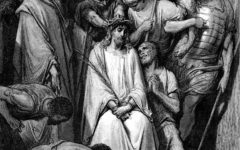
In this lesson, we will look at what Jesus did not do that most people would have done given the same circumstances. The listener should understand that Jesus was extraordinary in His behavior. We will conclude that Jesus was divine.