In 1 Corinthians 12-14, the apostle Paul addresses the abuse of miracles in the worship assembly. He concludes that section of teaching with this admonition: “Let all things be done decently and in order” (1 Corinthians 14:40).
For this I'm thankful (Hebrews 13:10-15): 1) The Creation, 2) The Bible, 3) Family and Friends, 4) The Church, 5) Jesus. Each person should consider how to be thankful.
It is good for a man not to touch a woman. 2 Nevertheless, because of sexual immorality, let each man have his own wife, and let each woman have her own husband. 3 Let the husband render to his wife the affection due her, and likewise also the wife to her husband.
The goal of this and all our efforts is to participate in God’s eternal purpose of building up His church (Ephesians 3:11)! God wants as many people to go to heaven as can possibly go, but He has left us responsible for taking the gospel to others (Matthew 28:18-20).
Because the kingdom of God is God’s people, we need to be busy serving God’s people. In my studies, I ran across Proverbs 18:1. The English Standard Version translates it like this: “Whoever isolates himself seeks his own desire; he breaks out against all sound judgment.” Because the kingdom of God is people, we are not to isolate ourselves but be part of the citizenry of the kingdom by participating in its activities. We value God’s kingdom—Christians—by giving ourselves away to others!
Knowing Christ and Him Crucified means having 1) God’s Wisdom, 2) The Mind of Christ, 3) God’s Temple. The objective of this lesson is to study and learn 1 Corinthians 2-3 in a structured way so as to understand and avoid the divisions of the church in Corinth.
A Christian who displays brotherly kindness is going to be 1) Gracious and Giving, 2) Challenging and Truthful, and 3) Affectionate and Loving. The hearer should understand what it means to love someone as a brother or sister in Christ by displaying the characteristics of brotherly kindness. The aim of this lesson is to familiarize the hearer with scriptures that discuss these qualities.
When you quench a fire, you put out the fire. When you quench your thirst, your thirst goes away. The word “spirit” here could refer to the Holy Spirit, or one’s own personal spirit. Either way, spirit is the source of all things spiritual. So the basic meaning of the command is not to put out the source of all things spiritual.
So usually when we read about the kingdom in the New Testament, it has reference to the church and vice versa. However, there are a couple of passages where the term kingdom doesn’t refer to the church, but to heaven.
Jesus washed feet to teach us to serve one another (John 13:3-15). When we "wash feet," we count others more significant than ourselves (Philippians 2:3-4).
To avoid building an empire of sinful desire we must 1) Know Our Own Desires, 2) Distinguish Between Legitimate and Illegitimate Desires, 3) Recognize Our Ultimate True Desire. The hearer should be able to impede sinful desires and facilitate desires for Jesus. In this sermon, I want to impart some spiritual tools whereby the hearer will be able to recognize his/her desires.
In this sermon we will examine the statement, "To The Blind He Gives Sight." He does this because there is, 1) A Need--the blind need to see, 2) A Name--only He has this authority, 3) A Notion--the blind who see will tell others, 4) A Nation--the blind who see will believe and worship together, and 5) A Night--an eternal blindness is coming for those who do not see. I want to impress upon each hearer that God wants all men to be saved and to come to the truth and to help the congregation become more evangelistic.
In this lesson we will learn that the life is in the blood as we compare the functions of blood with the functions of the blood of Christ: Blood 1) replenishes, 2) removes, 3) repairs, and 4) regulates. Each listener should recognize the function of the blood of Christ as it gives life to the body.
If I were a rich man, I would recognize, 1) my relationship with God regarding wealth, 2) the reasons God has given for wealth, 3) the problems associated with wealth. The hearer should be able to understand their responsibilities and attitudes toward wealth. I want everyone to have a proper, healthy, and reverent attitude toward the teaching within God's word regarding wealth.
Just as we learn from a Caddo canoe, we should value the simple, primitive words of Jesus. His yoke is easy and His burden is light (Matthew 11:28-30).
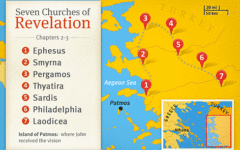
To the church of Philadelphia we have a message of 1) Opportunity, 2) Conquering, 3) Help in the time of need, and 4) Steadfastness. We should all be familiar with this letter and gain great encouragement from knowing that God continues to instruct and warn even when we are faithful.
In Revelation 16, God's righteous judgment falls on those who worship the beast. All will be judged by Christ's words (John 12:48), so let's live for Him.
Jesus is King of my life (1 Timothy 6:13-16) because 1) He Is My God, 2) He Is My Savior, 3) He Is My All. Each person should be able to state why Jesus is their King.