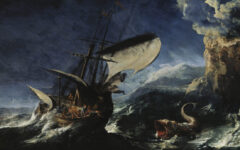
Escape from the Great Fish
In the story of Jonah we see 1) A Command, 2) A Contradiction, 3) A Confrontation, 4) A Correction. Each hearer should learn that when we ignore God’s commands, we forsake our own mercy.

In the story of Jonah we see 1) A Command, 2) A Contradiction, 3) A Confrontation, 4) A Correction. Each hearer should learn that when we ignore God’s commands, we forsake our own mercy.

Is love worth the risk? Rejecting the possibility of having love in our life is just another “rubber room,” a place where we will be protected from emotional pain, but at the loss of real relationships, which everyone actually desires most in this world. When we refuse to love others, we also fall into a profound self-absorption, a selfishness from which we will never recover. But to learn to love, we must risk suffering, and to risk suffering, we need a world that is not safe, sanitized, and preventative of all harm.

Why is there suffering? God made us free to choose, and suffering results from sin (Genesis 3:14-19). A world without consequences would be a "rubber room," not freedom.

We affirm the sanctity of life because 1) It has worth, dignity, and value—it is holy, 2) it is worth living, 3) it is worth protecting. In this lesson, I hope to counter the message of our contemporary culture that life is cheap, meaningless, and worthless for those who have no utility and affirm the sanctity of life.

Let us not be ashamed 1) To suffer as a Christian, 2) To teach and preach the gospel, 3) To own Jesus as our Lord. Each Christian ought to be more emboldened to act according to God's will, take the gospel message to others, and follow the example of Christ in their life. This lesson is designed to encourage the membership to be zealous in their Christianity.

The psalmist prays to God for life or revival in 1) Affliction, 2) Assurance, 3) Aggravation, 4) Authenticity. This lesson teaches us to turn to God and His word for revival and ongoing life because He is its source.
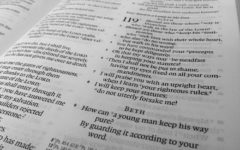
God’s word guides us through all of life’s circumstances: 1) Affliction, 2) Worship, 3) Decisions, 4) Persecution, and 5) The Future. Each hearer should know that they can trust in God’s word to guide them.

Everyone knows that person who wallows in self-pity. Ask them how they are doing, and their response is “I’m OK, I guess.”

Does Satan cause death? Sin brought death into the world when Satan tempted Eve (Genesis 3:1-7). Suffering, even of innocent children, comes from the consequences of sin.

In this part of Psalm 119, we will see that God’s word helps me to endure persecution. God 1) hears my request for relief, 2) sees the relentlessness of the wicked, and 3) provides respite when I yield to His word. Each listener should take comfort in knowing that God hears, sees, and provides when His people are persecuted.

God’s word provides for us in the time of our afflictions. It teaches us that 1) God is good; 2) Afflictions Refine the Righteous, 3) The wicked will not comfort us. Each hearer should understand that in times of distress we need to go to God and his word for comfort, peace, and help.

Patience (James 1:2-4) 1) Keeps Us Faithful, 2) Keeps Us Watching, 3) Keeps Us Working, 4) Brings Us Home to the Lord. Each person should practice this Christian grace.

Change direction for God (2 Chronicles 15:1-7) and 1) God Is with Us, 2) We Find Him in Trouble, 3) Our Work Is Rewarded. Each person should grow by changing for God.

Walking with Christ (1 Peter 2:18-25): 1) The Context, Persecution, 2) The Crux, Graciousness, 3) The Consequence, Fellowship. Each person should apply it to evangelism.

Jesus was a "man of sorrows" (Isaiah 53:1-3) because 1) He Lived as a Servant, 2) Many Rejected Him, 3) The Innocent Bore Our Sins. Each person should know why.
The "Angel of the LORD" is God Himself (Isaiah 63:9), seen 1) With the Patriarchs, 2) In the Exodus, 3) Among the Judges. Each person should see God working to save man.