

The Woman with the Alabaster Jar
Podcast: Play in new window | Download
Subscribe: RSS
Click to expand the full transcript of “The Woman with the Alabaster Jar”
Well, we have a lot that are out of town today and they’re doing what they’re doing this weekend and so we have a few that are here and so we’re glad to see you this morning and congratulations to all of our teachers. They have finished up their year here and are now going to enjoy their summer. We appreciate them so much and we’re glad that they have had a good teaching year and concluded those activities.
We’re not going to have a PowerPoint this morning, we’re just going to study from Luke chapter 7, and so I invite you to open your Bibles to Luke chapter 7, and let’s look together into God’s Holy Word. We’re going to be looking at verses 36 through 50 today, and thinking about this story in Luke’s Gospel titled, or the story that we know as, The Woman with the Alabaster Jar.
Well, let’s read together these verses, and then we’ll come back and draw some lessons from them. Verse 36. Then one of the Pharisees asked Him to eat with him, and he went to the Pharisee’s house and sat down to eat.
And behold, a woman in the city who was a sinner, when she knew that Jesus sat at the table in the Pharisee’s house, Now, when the Pharisees, who had invited Him, saw this, He spoke to himself, saying, “‘This man, if he were a prophet, would know who and what manner of woman this who is touching him, for she is a sinner.'” And Jesus answered and said to him, “‘Simon, I have something to say to you.'” So he said, “‘Teacher, say it.'” There was a certain creditor And 500 denarii, the other 50. And when they had nothing with which to pay, repay, he freely forgave them both. Tell me, therefore, which of them will love Him more?
Simon answered and said, “‘I suppose the one whom he forgave more.’ And he said to him, “‘You have rightly judged.’ Then he turned to the woman and said to Simon, “‘Do you see this woman? I entered your house. You gave me no water for my feet, but she has washed my feet with her tears and wiped them with the hair of her head.
He says, Your sins are forgiven. And those who sat at the table with Him began to say to themselves, Who is this who even forgives sins? Then He said to the woman, Your faith has saved you. Go in peace.
What a wonderful story that we find here about Jesus and the great attitude that He had toward other people. You know, we need to be more like Jesus every day. And Luke gives us something to think about in this story and to consider more about the Jesus that maybe we don’t know as well.
So let’s study this passage and think about several things and see what Jesus can teach us here. First of all, I want us to note this. Jesus responds to all invitations. We see that there’s this Pharisee, and he asked Jesus to eat with him. His name was Simon.
Now, it seems that Simon had ulterior motives. We don’t know exactly what all those were, but the text says he was a Pharisee, and it’s saying that for a reason, because the Pharisees loved to judge other people, and they loved to put people in their place, and that made them feel superior to others. He probably didn’t like what Jesus had said, and maybe he was trying to worm his way up He came up in the hierarchy of the Pharisees in that day and time and thought, well, if I invite Jesus to my house, then I’ll be able to get some goods on Him and I can use those goods to impugn Jesus and thereby show myself to be a righteous person to my fellow Pharisees.
Of course, that’s a wrong motive. Jesus would have known Simon’s motives. But notice that Jesus accepted the invitation anyway, and He went. You know, not a lot of us would have done that, probably. We probably would have said, oh, that’s Simon the Pharisee. I know what he’s like. I don’t know if I want to go to his house today. Maybe I’ll just stay away from him.
But Jesus didn’t. He went, knowing full well Simon had problems. But then we have another invitation here. It’s kind of an unspoken invitation, but nevertheless still yet one. The woman who came to wash Jesus’ feet, she invited Him to have His feet washed.
You know, the times and places back in those days, they did things a lot differently than we do today. We sit at tables with our feet on the floor when we eat, but when they sat to eat, they didn’t have their feet on the floor. They reclined on a couch, and so their feet were elevated, and they put their elbows down, and then they would, on one side, and they would kind of rest sideways, you know, like laying on a bed, and then they would eat And so Jesus’ feet were up, and it says this woman was standing up when she started washing Jesus’ feet. She was standing behind His feet. His feet were on this couch, and so she could wash them while she was standing up. And Jesus didn’t have His feet on the floor. He had them elevated.
But she comes out and she starts washing Jesus’ feet. I suppose Jesus could have said, Oh, don’t do that, please. But it was an unspoken invitation, and Jesus accepted it. There’s no indication that she was invited to the house like Jesus was. Luke said plainly, and just as a matter of fact, she was a sinner. This would have been a real risk for her.
She risked incurring Simon’s wrath against her, but Jesus nonetheless permitted her to wash his feet. How do we invite Jesus today? Do we invite Him like Simon did with a pharisaical attitude, thinking, oh, I’m going to show something to Jesus. I’ll get something over on Him. Or do we invite Him like the woman does?
With a humble attitude, willing to serve, ready to risk our lives to help. Revelation 3, verse 20, Jesus says, Behold, I stand at the door and knock. If anyone hears my voice and opens the door, I will come into him and dine with him and he with me.
How do we dine with Jesus today? Jesus responds to all invitations. But then secondly, Jesus chose to see the good in people, not the bad. You know, when you look at the contrast between Simon and this woman. The text makes it clear, you know, Simon was probably someone of a great statue in the community. He was a Pharisee. The Pharisees liked to be in higher-up places, and they were probably well-respected in their day and time by generally most people. And so, the most people of that day would have looked at Simon and said, well, there goes Simon, you know, Well, he’s a well-respected guy in the community. But then Luke tells us that this woman, she was a sinner, not respected at all. We don’t know what kind of sin she was involved in. Maybe she was a prostitute. Maybe she was involved in some questionable business dealings. We don’t know what her sin was, but she was evidently not in favor among the people. And even Simon knew what her reputation was. It wasn’t hidden.
And yet, Jesus chose to see the good in her, not the bad. The alabaster jar that she had was a common container for perfumes for women in that day, and they were very expensive because they had to be made in such a way so that the lid would be sealed when the alabaster hardened.
They would make the jar and they would put the perfume or the ointment into the jar and then while the alabaster was still soft, they would seal the top of the jar so you had to literally break the jar to get the ointment out and you could never put the lid back on it again. You had to use it all at that one opportunity.
Well, that was a costly gift. When Simon looked at this woman, he saw her as a sinner to be rejected. We don’t know why. We don’t know what her sin was. We don’t even know why she was in his house other than the fact that she had heard that Jesus was there and she wanted to come see Jesus and do something for Jesus.
But there’s a question here that isn’t asked. And that question is simply this. Simon was a Pharisee. He knew the law of Moses. He knew the prophets. He knew all the teaching of scripture. And yet, when he looked at her and judged her, he didn’t wonder what it would take for her To change. For her to repent. Why hadn’t He asked her to repent? Why hadn’t He sought her out so that she could restore her relationship with God? Evidently, He hadn’t thought of that. But Jesus saw her as a person to be accepted.
He saw godly sorrow for her sin, for godly sorrow produces repentance leading to salvation not to be regretted, 2 Corinthians 7.10. He saw her giving spirit. He saw her love for others in the great sacrifice that she made. And we’re reminded that Jesus came to save sinners.
This is a faithful saying and worthy of all acceptance, that Christ Jesus came into the world to save sinners, of whom I am chief, 1 Timothy 1 and verse 15. Hebrews 4 and verse 15 says, For we do not have a high priest who cannot sympathize with our weaknesses, but was in all points tempted as we are, yet without sin.
Jesus chose to see the good, not the bad. But then third, Jesus sees and knows real sacrifice. This woman brought the best that she had to Jesus. This alabaster jar with ointment in it, they were considered to be very expensive in that day and time.
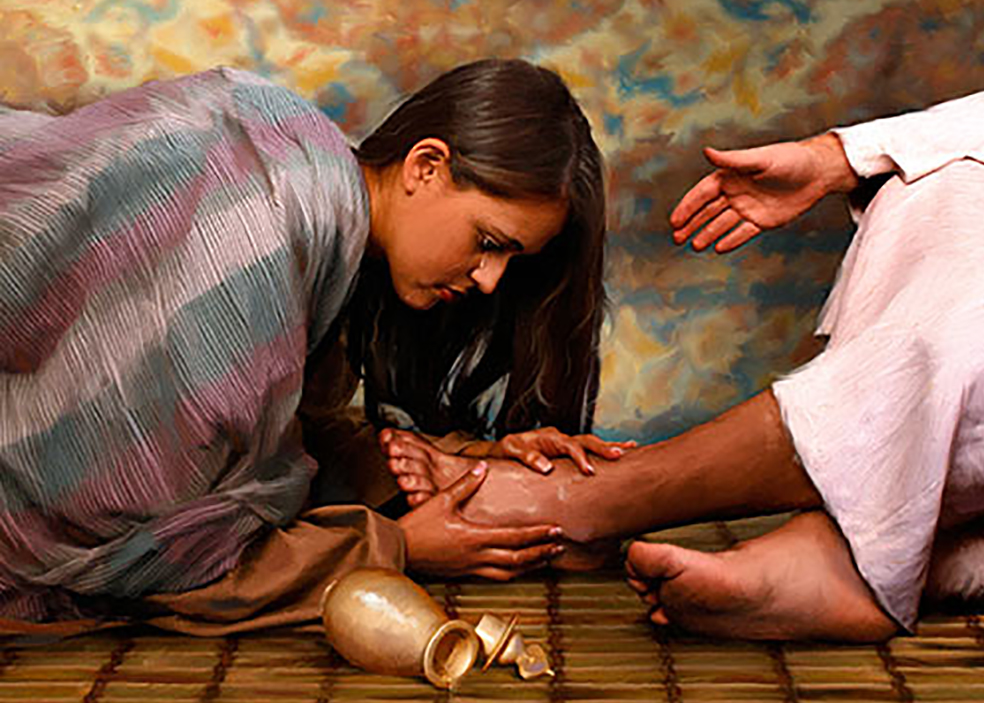
But not only did she bring that, she brought her tears. She brought her hair, a woman’s crown in glory. She even brought her lips to kiss Jesus’ feet. In all aspects, she showed a real sacrifice. Picture that scene there. Jesus reclined on a bench-type seating arrangement with a table in front of Him, His feet out this way, away from the table, Simon perhaps on the other side, the woman standing at Jesus’ feet, weeping, crying, tears coming out of her eyes, flowing down her cheeks, washing onto Jesus’ feet, and then, as they do so, So she bends down with her hair and wipes them away, breaks the jar, pours the ointment on His feet. The room fills with the aroma. Psalm 51 and verse 17 says, The sacrifices of God are a broken spirit, a broken and a contrite heart. These, O God, you will not despise.
You know, while Simon treated Jesus as an inferior, she treated Jesus as someone important and special and deserving of love. And so when Jesus, or when Simon criticizes this woman, you know, kind of surreptitiously, privately to himself, he kind of mutters, well, you know, Jesus knew who this woman was. She wouldn’t have had anything to do with that guy or that girl, you know, whew, that’s really something.
And so now he’s got his dirt. Now he’s got his gossip. Now he’s got the thing that he can take back to his other Pharisees and show them how great he is It’s because he’s got something on Jesus. But you know, Jesus doesn’t let that stop him. He turns to Simon and he says, Simon, when I came into your house, did you offer me some water so that I could clean my feet? Of course, no, he didn’t.
Did you greet me with a kiss? No. Did you offer some oil for my head to anoint me with? Did you treat me like you’re supposed to treat a guest in your home? No. We see Jesus knows the difference between our attitudes, between true devotion and pretension. When we come to worship, what’s in our heart? Are we really devoting ourselves to God and to His Son, Jesus Christ? Are we just going through the motions?
Simon just went through the motions because he really never intended to honor Jesus to begin with. But this woman did something great. Jesus judged the Pharisees in Matthew 15, 7 through 19. He said, He said, “‘Hypocrites, well did Isaiah the prophet say concerning you. These people draw near to me with their mouth and honor me with their lips, but their heart is far from me, and in vain they worship me, teaching for doctrines the commandments of men.'” He said in Matthew 23, 5, “‘But all their works they do to be seen by men.'” Why are we here?
To be seen by men, to elevate our status in the community, to make something of ourselves, or are we here for Jesus? And then finally, we see in this story that Jesus rewards faith. Simon invited Jesus to dinner to confirm his disbelief. He didn’t treat Jesus like a guest.
He questioned Jesus’ reputation as a prophet, much less the Messiah. He and his friends at the table expressed dismay that Jesus forgave sins. Why? Who can do that? They were like the foolish man who built his house on the sand. They heard Jesus’ words, but they didn’t put them into practice.
Matthew 7, 26 and 27. But this woman, when she came to dinner, she came to express her faith. She sought Jesus out where she wasn’t wanted. She gave Jesus her most costly possession. She sacrificed of her own person, her own tears.
She believed that Jesus was the rock of her salvation and that no one else but Jesus could help her. She expressed the faith of which we read in 1 John 5 and verse 4. For whatever is born of God overcomes the world, and this is the victory that has overcome the world, even our faith.
And so Jesus forgave her sins. You know, the text doesn’t even say that she asked for forgiveness. But Jesus forgave them anyway. He had mercy on her because of her devotion, her contrition, her repentance. He said, your sins are forgiven. Your faith has saved you. Go in peace.
And she received forgiveness and peace because of her faith. Why would Jesus do this for her? Because He loved her. And God loves all of us, and He wants all of us to have the same attitude toward our lives, toward ourselves, and toward His Son, Jesus Christ.
Now, Jesus loved Simon too, but He couldn’t forgive Simon. And why was that? It wasn’t because Jesus wasn’t willing. We could have had a dual forgiveness in this story. If Simon had just said, you know what, Jesus, you’re right. I’m sorry. I judged my fellow Jew, my sister under Moses. I consider her less than nothing, and my attitude was wrong, and I should repent.
Repent of that. And Jesus would have said, Simon, you’re forgiven. But He didn’t. Why? Because Simon didn’t want to be forgiven. He didn’t think he had done anything wrong. And that’s the greatest obstacle to forgiveness that we have today.
What a story. How it teaches us to be merciful like Jesus. Jesus responds to all invitations. How are we inviting Him into our lives? Jesus chooses to see the good in people, not the bad. He wants to see the good things in your life.
He wants to look at you and say, look at my precious brother. Look at my precious sister. He sees and knows real sacrifice. He can see the deepest secrets of your lives, and yet, He only looks at the good things, and He rewards faith in Him. Would you put your faith and trust in Jesus today? Today, you can come to Jesus, invite Him into your life by hearing His Word And believing it. Repenting of your sins. Confessing Him as Lord and being baptized for the forgiveness of sins. Yes, Jesus forgives. And He wants you to be forgiven. And maybe this morning you would like to have that happen. Or maybe you need prayer. And like this woman, you’ve got problems that you need to have dealt with in your life. You can have those problems dealt with today. We can work with you and help you and pray with you.
Whatever your need may be, you can come and make it known right now while together we stand and while we sing.
End of transcript. Thank you for reading along!
 SUBJECT: Jesus
TITLE: The Woman with the Alabaster Jar
PROPOSITION: We will study Luke 7:36-50 and see that 1) Jesus responds to all invitations in some way, 2) Jesus chose to see the good in people first, not the bad, 3) Jesus sees and knows real sacrifice, 4) Jesus rewards faith in Him.
OBJECTIVE: In this lesson we want to understand how Jesus looks at people so that we can see them the way He does.
INTRODUCTION:
1. Read: Luke 7:36-50
2. About the Text:
1) We need to be like Jesus more and more every day.
2) This story from Luke teaches us some things about Jesus that we need to know.
3. Ref. to S, T, P, O, and A.
DISCUSSION:
I. Jesus Responds to All Invitations
1. Simon invited Jesus to his house.
1) Jesus did not reject him.
2) What were Simon’s motives?
3) He was a Pharisee.
4) He probably didn’t like what Jesus had to say.
2. The woman invited Jesus to have his feet washed.
1) She was not invited to the house.
2) Luke says she was a sinner.
3) This was a real risk for her.
4) Jesus let her wash his feet.
3. Will we invite Jesus today?
1) He wants us to invite Him into our lives.
2) “Behold, I stand at the door and knock. If anyone hears My voice and opens the door, I will come in to him and dine with him, and he with Me” (Revelation 3:20).
3) We need to listen to what Jesus has to say.
II. Jesus Chose to See the Good in People, not the Bad.
1. Luke made it clear that this woman was a sinner.
1) She may have been a prostitute as some have suggested.
2) The alabaster jar she had was a common container for perfumes for women.
2. Simon saw her as a sinner to be rejected.
1) Was it because of her reputation? Or his experience?
2) He may have seen her as ritually unclean.
3) But what is she doing in his house?
4) Why hadn’t Simon called her to repentance?
3. Jesus saw her as a person to be accepted.
1) He saw her godly sorrow for her sin – “For godly sorrow produces repentance leading to salvation, not to be regretted; but the sorrow of the world produces death” (2 Cor.7:10).
2) He saw her giving spirit.
3) He saw her love for others in her sacrifice.
4. Jesus came to save sinners.
1) “This is a faithful saying and worthy of all acceptance, that Christ Jesus came into the world to save sinners, of whom I am chief” (1 Timothy 1:15).
2) “For we do not have a High Priest who cannot sympathize with our weaknesses, but was in all points tempted as we are, yet without sin” (Hebrews 4:15).
III. Jesus sees and knows real sacrifice.
1. The woman brought her best to Jesus.
1) She cleaned Jesus feet with her tears.
2) She used her hair, a woman’s crown and glory, to dry Jesus’ feet.
3) She even kissed Jesus’ feet.
4) The alabaster jar held expensive perfume that could only be used once.
5) In all aspects, she offered Jesus a real sacrifice.
6) Psalm 51:17 “The sacrifices of God are a broken spirit, A broken and a contrite heart—These, O God, You will not despise.”
2. Simon treated Jesus as an inferior.
1) He did not offer water to Jesus to clean his feet.
2) He did not greet Jesus with a kiss, which was customary.
3) He did not offer Jesus oil for his head.
4) Simon invited Jesus into his home to judge Him, not to learn from Him.
5) This is clear from verse 39.
3. Jesus knows the difference between sincere devotion and pretension.
1) “Hypocrites! Well did Isaiah prophesy about you, saying: ‘These people draw near to Me with their mouth, And honor Me with their lips, But their heart is far from Me. And in vain they worship Me, Teaching as doctrines the commandments of men’” (Matthew 15:7-9).
2) “But all their works they do to be seen by men” (Matthew 23:5).
IV. Jesus rewards faith in Him.
1. Simon invited Jesus to dinner to confirm his disbelief.
1) He didn’t treat Jesus like a guest.
2) He questioned Jesus’ reputation as a prophet, much less, the messiah.
3) He and his friends at the table expressed dismay that Jesus forgave sins.
4) They were like the foolish man who heard Jesus’ words, but did not do them (Matthew 7:26-27).
2. The woman came to dinner to express her belief.
1) She sought Jesus out where she wasn’t wanted.
2) She gave Jesus her most costly possession.
3) She sacrificed of her own person.
4) She believed that Jesus was the rock of her salvation.
5) “For whatever is born of God overcomes the world. And this is the victory that has overcome the world—our faith” (1 John 5:4).
3. Jesus forgave her sins, but not Simon’s.
1) Jesus had mercy to her because of her devotion, contrition, and repentance.
2) He said to her, “Your sins are forgiven.”
3) He said to her, “Your faith has saved you; go in peace.”
4) She received forgiveness and peace because of her faith.
5) Why would Jesus do this for her? Because he loved her.
6) Jesus loved Simon too, but could not forgive him because he wouldn’t let Jesus do it.
CONCLUSION:
1. From this story we learn about Jesus.
1) Jesus response to all invitations.
2) Jesus chooses to see the good in people, not the bad.
3) Jesus sees and knows real sacrifice.
4) Jesus rewards faith in Him.
2. Invitation