

Who Wrestles with God?
Podcast: Play in new window | Download
Subscribe: RSS
Click to expand the full transcript of “Who Wrestles with God?”
Wrestling with God! How do you win a wrestling match against God? And that’s something that I’ve given some thought to in the past and there’s only one way, and, of course, that’s if God lets you win because we don’t have hope of winning against Him. Otherwise, why do we want to talk about wrestling with God? When I think about wrestling with God, I think about how weak I am. I was weak as a child. I had a childhood friend who lived down the road for me, and we would get together and play. I could never win against him. He was stronger than I was and as much as I tried to beat him in many things, it just didn’t happen because ultimately he was stronger. What is strong and what is God and who is God; we think about God. We think about ultimate reality about all things that are real and true and right and good, and one of humanity’s greatest problems, perhaps the greatest problem, is the inability to accept what is real.
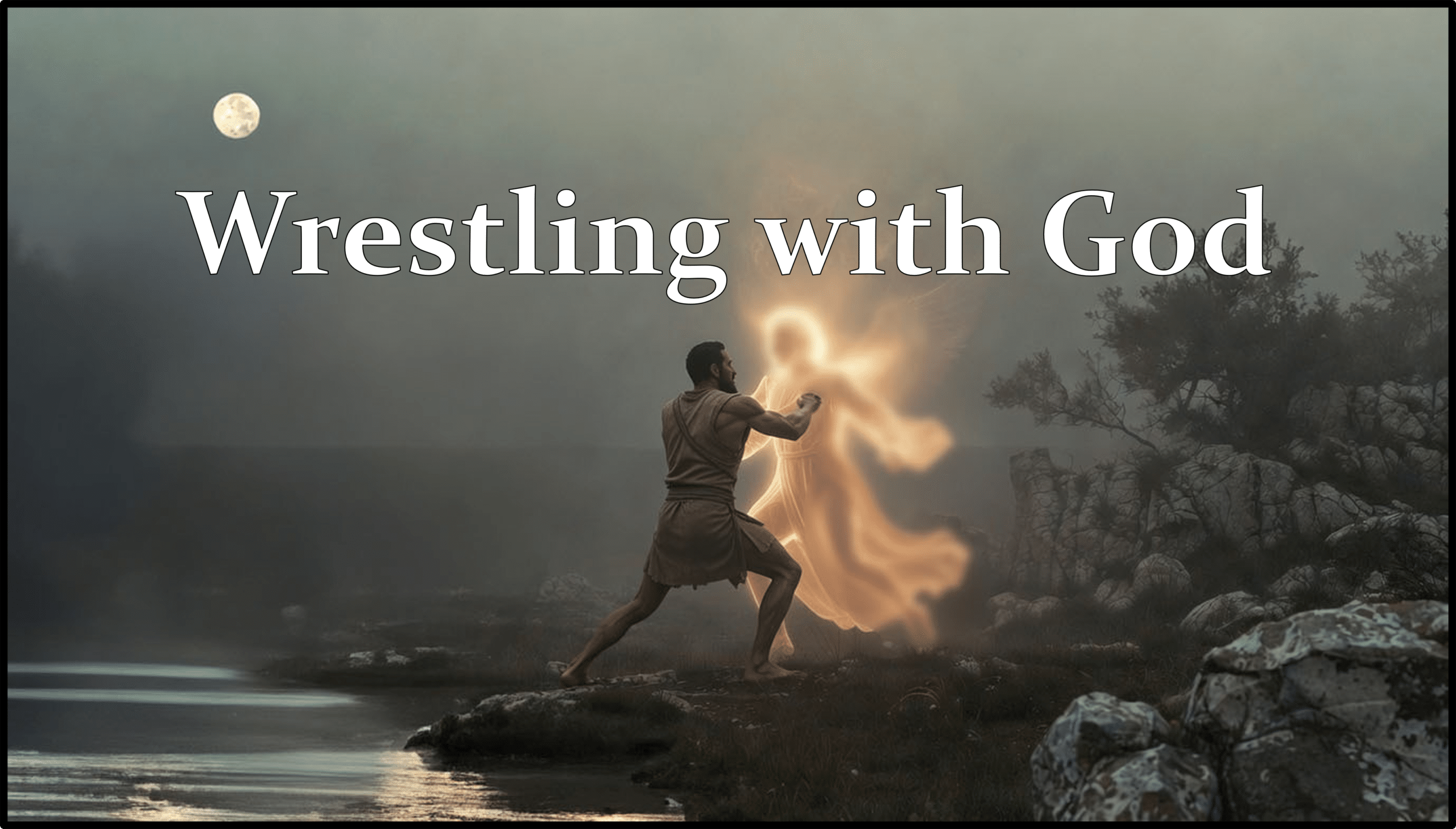
Let’s come back to that thought a moment as we think about Genesis 32:24 through 28. Here we read the Bible. “And Jacob was left alone and a Man,” (some your Bibles have the word Man capitalized, and rightly so) “a Man wrestled with him until the breaking of day. Now when He saw that He did not prevail against him, He touched the socket of his hip; and the socket of Jacob’s hip was out of joint as He wrestled with him. And He said ‘let me go for the day breaks.’ But he said ‘I will not let You go unless You bless me.’ So He said to him, ‘What is your name?’ He said ‘Jacob’ and He said ‘Your name shall no longer be called Jacob, but Israel; for you have struggled with God and with men and have prevailed.”
We will talk about Jacob in a few moments but let’s talk about that tension that we have between ourselves and between God, because the truth is, Jacob had been wrestling with God all his life, not just in that one moment. That one moment was symbolic of everything that he had been through to that point. And as we live our lives, there are things that we come across that are difficult to handle and we don’t know quite how to approach them. Sometimes we do well and sometimes we don’t. But as we encounter ultimate reality—God is ultimate reality—it can be uncomfortable for us.
It is uncomfortable to talk about wrestling with God. When we know that God is going to win and we’re going to lose, if we try to exert our own power against Him. It is uncomfortable thinking of ourselves as struggling when we don’t want to struggle. We want to be confident, assured; we want to go forward; we want to conquer; we want to prevail and yet we don’t, because sometimes we build lies. We create false images of ourselves other people and of God. And then we erect those false images and we look at then we say “Aha! Look what I have done!” When, in fact, we haven’t done anything other than lie to ourselves.
And so, there is tension there—tension between self and God between ultimate reality and the images that I construct and that you construct within your own mind. What do we want to see in each other? What do I want to see in myself? What you want to see in yourself? What do we want to see in God? And really that’s the wrong question because it shouldn’t be about what we want, but who God is and what we think about the Scriptures and who is presented in the Bible, namely Jesus Christ.
There is an image there that God presents: the image of Christ, let’s call it, and that is the image we need to see in ourselves and that we need to see in one another. Romans 8 verse 29 says it like this, “For whom he foreknew he also predestined to be conformed to the image of his son, that He might be the firstborn among many brethren.” And we are exhorted in Colossians 3 verse 10 to “Put on the new man who is renewed in knowledge according to the image of Him who created Him.” There is an image that God wants us to see, to understand and to apply but so many times we reject that image for a creation of our own and in so doing, we wrestle with God.
Now let’s think about this morning about who wrestles with God. We will look at three things. First of all, we see that Jacob wrestled with God. Secondly Jesus wrestled with God and number three, we wrestle with God. And this is going to be our theme for the year, “Wrestling With God.” And as we think about wrestling with God this year, you think about the standard that God has for us to follow in and what that standard isn’t and how we wrestle with that standard, how we come to apply it, both in a personal way and in a corporate way as the body of Christ, the local body here. And how we are to take that standard to others around us in the world today and you know as we do that it is not easy. If it were easy, Jesus wouldn’t have had to die on the cross. It’s not easy. We wrestle with God. We wrestle how to do this and we want to discuss that and think about that this year wrestling with God.
First of all, Jacob wrestled with God. Now one of the things that Jacob wrestle with, and that we wrestle with, is scripture. And scripture gives us the standard. It gives us the overview, if you will, it gives us the direction. But so many times we take that direction and we pervert it; we change it. We don’t do what we’re supposed to do with it. Well, Jacob had some direction over his life. And maybe you remember the story of Jacob and Esau and their birth in the Bible, and in Genesis chapter 25 we read the story. But there is a prophecy about Jacob and Esau and the prophecy was “The older shall serve the younger.” Seems simple enough, but then Jacob saw this prophecy heard this prophecy, no doubt, from his mother and father, and then wanted to fulfill this prophecy in his own way. And that’s the beginning of the trouble in some way.
You see, Jacob was the supplanter who grabbed his brother’s heel at birth. Genesis 25 in verse 26. And then as they grew together, one day Esau was out in the field and he didn’t get anything to eat. He came back in. Jacob was there with a bowl of beans, more or less, and he sold his birthright for a bowl of beans. The Bible says Jacob is the supplanter, or the one who is trying to take advantage. “How can I fulfill this prophecy. I’ll fulfill it by taking away Esau’s birthright and I’ll do it right here. According to my own will. My own power.”
Well, that wasn’t enough, because (well, I went a little too far [with the slide show]) but that was enough because Jacob later conspired with Rebecca to deceive Isaac for Esau’s blessing. In Genesis 27 and as we see his actions: lying and cheating and defrauding his brother of the things that were rightfully his. We think, “What? Why, Jacob? Why would you act in this way?” The only answer that I can think of is that Jacob was, through his own power, trying to fulfill that prophecy, “The older shall serve the younger.” And he wanted that to happen more than anything else and he was willing to do anything to get it done course. This led to some very bad relations between Jacob and Esau and ultimately Esau wanted to kill Jacob, Genesis 27 verse 41 says.
And so, Rebecca tells Jacob, “You need to get out of town. You go to my uncle in Haran, my uncle Laban. You go there and escape from Esau’s wrath.” So, Jacob goes to Haran and there he meets a beautiful young woman, Rachel, and he wanted to marry Rachel and he was willing to serve seven years for her, Genesis 29:20 and 30 says.
And while he was in Laban’s house, The supplanter became the supplanted because Laban took advantage of Jacob. What happened after seven years? Did he give Jacob Rachel? No. But the other sister Leah instead. And now he’s got a mess on his hands because he got two wives and two concubines and 12 kids on the way, and what is he going to do about it. Well, he stays in Laban’s house for 20 years before he returns to the land of Canaan, according to Genesis 31, and finally he up and decides, “You know what? It’s time to go.”
But Laban doesn’t like this very much, and he pursues Jacob intending to get what he considers to be his own property back. In Genesis 41 verse 43 Laban tells Jacob, “The children are mine. The cattle are mine. The sheep are mine. All what you have is mine.” And he was going to take it by force, if God hadn’t stopped him. God tells Laban to back off, and they make a covenant and they heap up a heap of rocks. Now, Jacob cannot go back. Jacob made a covenant with Laban. Genesis 31:52, “I will not pass beyond this heap to you and you will not pass beyond this heap and this pillar to me.” And so his time was over.
But there was a problem. Jacob was on his way back to Canaan, and who lived in Canaan. Esau did. And the last time he saw Esau, he wanted to kill him. And so Jacob hears that Esau is sending 400 men. He can’t go back. Laban is there preventing him. He can’t go forward. Esau was there preventing him. What can he do? He gets down on his knees and prays. That’s what he does. And this is his prayer, here in Genesis 32:10 through 11. He says “I am not worthy of the least of all the mercies and of all the truth which you have shown your servant; for I crossed over this Jordan with my staff and now I have become two companies. Deliver me, I pray, from the hand of my brother from the hand of Esau; for I fear him, lest he come and attack me and the mother with children.”
It is after this that we have the story of Jacob wrestling with God. Why is it that? And prevailing! Why is that? Because he finally realizes that it’s not in his power to save himself, but God’s. And so, Jacob wrestled with God.
But Jesus also wrestled with God, and I think there’s a very different situation here. We think about Jesus wrestling with God versus Jacob wrestling with God. Was there prophecy about Jesus? Of course there was. In fact, the temptations of Jesus Christ involve multiple prophecies about what the Messiah would be and do. And you may remember the words of the devil when he was tempting Jesus. “If you are the son of God turn these stones to bread. If you are the son of God, cast yourself off the temple. Why go ahead and approve it right now Jesus by doing these things that everyone will believe that you are the son of God and the Messiah.” What a temptation!
Jesus was the Messiah. No doubt he wanted to prove that just like Jacob wanted to prove that the older would serve the younger and did everything he could to try to prove that and taking the birthright, taking the blessing, using sinful means to do it. But Jesus would not. He would not use the sinful means that Jacob used to fulfill prophecy even in the temptations. The final one being the prophecy in Psalm two about asking for the nations and I will give them to you. There, Satan says, “Well, if you’ll just bow down to me, I’ll give you all the nations.” The prophecy would be fulfilled. Jesus would be shown to be the Messiah. But that wasn’t what God wanted. And so Jesus didn’t give in. Even though he could have “fulfilled the prophecies” (quote unquote). What did he do instead? He refused to bow to the devil. He refused to do evil that good may come. And he did not sin. No doubt this was incredibly taxing and stressful and difficult for him to do. And we face stressful, difficult, taxing things in life that we must think about and wrestle with just as Jesus wrestled.
What about Jesus and those Jewish leaders who regularly tried to entrap him to test him (Matthew 16:1, Matthew 19:3). They were envious of him, Mark tells us in Mark 15:10. They handed him over because they were envious of him. They feared losing the nation to the Romans (John 11:48). They were envious of his influence. They were envious of the people who followed him, they feared that the Romans would take their government away from them, take their power away from them. And so they conspired to arrest to try and to crucify Jesus and, in the very manner in which Jacob himself tried to fulfill Scripture, they fulfilled Scripture in reference to Jesus the Messiah.
And yet Jesus the whole time. Having 12 legions of angels available to him would not so act so as to take what was rightfully his by force. To the contrary, he bowed his head in the garden of Gethsemane and there fulfilled the prophecy that was written about him in Isaiah 53:9 which said “because he had done no violence, neither was any deceit in his mouth.” Unlike Jacob, who did violence, who did deceit, Jesus did not. But in that garden. He prayed and he wrestled with God and maybe you remember that prayer: “Father, if it is your will take this cup away from me. Nevertheless, not my will but yours be done.” “And being in agony,” the scriptures say, “he prayed more earnestly. Then his sweat became like great drops of blood falling down to the ground.” Agony—it’s the Greek word for wrestling: agonizomai. Struggling, wrestling with his own identity and with the Father’s will. He wrestled with God, but he did not give into the temptation to sin. First Peter 2:23-24 says, “Who, when he was reviled did not revile in turn when he suffered, did not threaten, but committed himself to him who judges righteously who himself bore our sins in his own body on the tree, that we, having died to sins, might live for righteousness by whose stripes you were healed.” And through him, we then can overcome just as he did, by having the same mind, by having the same attitude, by having the same obedience. He took the form of a servant. He made himself in appearance as a man. He humbled himself and became obedient to the point of death. Humility wins the wrestling match with God.
We wrestle with God. We wrestle with God just like Jacob did, just like Jesus did to perform scripture we know what the standard is, the word of God. We want to be the “worker who does not need to be ashamed, rightly dividing the word of truth.” And yet we take Scripture sometimes and we misuse and abuse it for own purposes. We recognize that it is there “for reproof, correction instruction in righteousness, that the man of God may be complete, thoroughly equipped for every good work” (2 Timothy 3:16-17). It is the standard, but how many times do we perfectly live up to the standard. I daresay there is not one here who has. And so we wrestle with God.
We wrestle with God to overcome temptations and struggles that we face in this life. Even Jesus recognized that we need to wrestle when he said, “strive”—that’s our Greek word agonizomai—”strive” (agonize, wrestle) “to enter through the narrow gate. For many, I say to you will seek to enter and will not be able.” Temptations come our way and we have help with those temptations, but we must strive, we must wrestle, to overcome them.
Colossians 1:28-29 talks about the standard of Jesus Christ and setting him forth as the one that we must use to overcome. “Him, we preach, warning every man and teaching every man in all wisdom, that we may present every man perfect in Christ Jesus. To this end, I also labor, striving” (wrestling, there’s our Greek word agonizomai) “according to his working, which works in me mightily.” God helps us. He works with us so that we can overcome. He has a working. I have a working. My working must be his working and that’s how it has to work for me to wrestle and to overcome. “Fight the good fight of faith, lay hold on eternal life to which you are also called and have confessed the good confession in the presence of many witnesses” (1 Timothy 6:12). We wrestle with God to do what is right.
Will we humble ourselves as Jesus did? That’s the question we each must ask. That’s the prayer we each must pray as we seek to wrestle with God: not my will but yours be done. Jacob wrestled with God. Jesus wrestled with God. We wrestle with God. Wrestling with God—it deserves some thought. It deserves tremendous amount of consideration as we go forward into 2026. There’s so many things we could talk about in this regard, but the bottom line is we must humble ourselves, if we seek to prevail with God. That’s how Jacob ultimately prevailed. That’s how Jesus prevail, and it is how we will prevail as well by being humble and not trying to use the power of my own to overcome the struggles of this life, not creating a false image that I can set forward and look at it and say, “Aha! I have accomplished something.” But rather simply listening to God’s word and applying it faithfully in our lives.
Would you wrestle with God? We are all wrestling with God one way or another, whether we realize it or not. Let’s make our wrestling like the wrestling of Jesus Christ to do what is right each and every day, to take the word and apply it faithfully, to live in a way that’s going to bring honor and glory to him, not self.
Do you need to prevail with God this morning? Maybe you’re wrestling with him right now on whether or not to become a Christian, whether not to become a child of God. Jesus told us what we need to do for that to happen: hear his word and believe it, repent of sin, confess him as Lord and be baptized. And, there’s many who wrestle with that. Humble yourselves this morning. Give yourself to him and prevail. It is the only way to prevail. How do you win wrestling match with God. There’s only one way and that’s if He lets you and He will let you win if you humble yourself before Him, and you can do that right now while together we stand and sing.
End of transcript. Thank you for reading along!
TITLE: Who Wrestles with God?
SUBJECT: Wrestling with God
PROPOSITION: Who wrestles with God? 1) Jacob wrestled with God, 2) Jesus wrestled with God, 3) We wrestle with God.
OBJECTIVE: Each person should understand that there is a constant tension between self and God and that we must humble ourselves before Him.
INTRODUCTION: Who Wrestles with God?
1. Read: Genesis 32:24-28
2. About the Text:
1) Who wants to wrestle with God?
2) But do we wrestle with God? We do.
3) How do you win a wrestling match with God?
4) First Sundays: “Wrestling with God.”
3. Why do we want to talk about wrestling with God?
1) God is ultimate reality.
2) Foundationally, humanity’s greatest problem is refusal to accept reality.
3) We build false images – idols of lies.
4) We build images of ourselves, other people, and God.
5) There is tension between self and God, between ultimate reality and the images I build.
6) What do we want to see in each other? An image of Christ or an image of “me.”
7) Romans 8:29 “For whom He foreknew, He also predestined to be conformed to the image of His Son, that He might be the firstborn among many brethren.”
8) Christ is the image of God – Colossians 1:15
9) We must put on His image – Colossians 3:10
4. Ref. to S, T, P, O, and A.
DISCUSSION: Who Wrestles with God?
I. Jacob Wrestled with God
1. Prophecy
1) Prophecy about Jacob – “the older shall serve the younger” (Genesis 25:23).
2) Jacob – supplanter, grabbed his brother’s heel at birth (Genesis 25:26).
3) Jacob defrauded Esau of his birthright for a bowl of lentils (Genesis 25:33-34).
4) Jacob conspired with Rebekah to deceive Isaac for Esau’s blessing (Genesis 27).
5) Jacob seems to be trying to fulfill the prophecy himself with his own sinful power.
2. Jacob and Laban
1) Esau wanted to kill Jacob (Genesis 27:41).
2) Jacob escapes to Haran to Uncle Laban’s house (Genesis 27:43).
3) The supplanter becomes the supplanted.
4) Laban takes advantage of Jacob – 7 years for Rachel and another 7 for Leah (Genesis 29:20, 30).
5) After 20 years he resolves to return to the land of Canaan (Genesis 31).
6) Laban does not like this; he pursues Jacob intending to get what he considers his property back (Genesis 41:43).
7) God intervenes and tells Laban to back off (Genesis 31:24).
8) Jacob made a covenant with Laban and cannot go back (Genesis 31:52).
3. Jacob wrestles with God.
1) Jacob hears that Esau is on his way with 400 men (Genesis 32:6).
2) The last time he saw his brother, he wanted to kill him.
3) He prays and confesses that he is not worthy (Genesis 32:10).
4) He recognizes his inability to save himself (Genesis 32:11).
5) It is after this that Jacob wrestles with God.
II. Jesus Wrestled with God
1. Jesus the Messiah/Christ
1) Like Jacob, there are prophecies about who the Messiah.
2) We see these in Jesus’ temptations.
3) The Spirit led him up into the wilderness (Matthew 4:1).
4) Satan himself tempts Jesus to sin.
a. Turn the stones into bread (the miracle of manna, John 6:30-31).
b. Throw yourself off the pinnacle of the temple (Psalm 91:11-12).
c. Bow down and worship the devil for all the kingdoms of the world (Psalm 2:7-9).
d. These are all temptations that would confirm prophecy and prove Jesus to be the messiah.
5) Unlike Jacob, Jesus did NOT sin in an effort to fulfill prophecy.
2. Jesus and the Jewish Leaders
1) They regularly tried to entrap Jesus (Matthew 16:1, 19:3).
2) They were envious of Him (Mark 15:10).
3) They feared losing the nation to the Romans (John 11:48).
4) They conspired to arrest, try and crucify Jesus.
3. Gethsemane
1) Jesus knew what they wanted to do, but would not respond in kind.
2) The prophecy of Isaiah 53:9 said, “because he had done no violence/wrong, neither was any deceit in his mouth” (See also 1 Peter 2:22).
3) So Jesus prayed and wrestled with God.
4) “Father, if it is Your will, take this cup away from Me; nevertheless not My will, but Yours, be done” (Luke 22:42).
5) “And being in agony, He prayed more earnestly. Then His sweat became like great drops of blood falling down to the ground” (Luke 22:44).
6) “who, when He was reviled, did not revile in return; when He suffered, He did not threaten, but committed Himself to Him who judges righteously; who Himself bore our sins in His own body on the tree, that we, having died to sins, might live for righteousness-by whose stripes you were healed” (1 Peter 2:23-24).
7) “Let this mind be in you which was also in Christ Jesus, who, being in the form of God, did not consider it robbery to be equal with God, but made Himself of no reputation (emptied himself), taking the form of a bondservant, and coming in the likeness of men. And being found in appearance as a man, He humbled Himself and became obedient to the point of death, even the death of the cross” (Philippians 2:5-8).
III. We Wrestle with God
1. We wrestle with God to perform scripture.
1) “Be diligent to present yourself approved to God, a worker who does not need to be ashamed, rightly dividing the word of truth” (2 Timothy 2:15).
2) “All Scripture is given by inspiration of God, and is profitable for doctrine, for reproof, for correction, for instruction in righteousness, that the man of God may be complete, thoroughly equipped for every good work” (2 Timothy 3:16-17).
3) We wrestle by measuring ourselves against God’s word (James 1:25).
2. We wrestle to overcome temptations.
1) “Strive to enter through the narrow gate, for many, I say to you, will seek to enter and will not be able” (Luke 13:24).
2) “No temptation has overtaken you except such as is common to man; but God is faithful, who will not allow you to be tempted beyond what you are able, but with the temptation will also make the way of escape, that you may be able to bear it” (1 Corinthians 10:13).
3) Jesus gives us forgiveness to try again (1 John 1:7).
3. Jesus wrestles with us to do what is right.
1) We are wrestling for an imperishable crown (1 Corinthians 9:25).
2) “Him we preach, warning every man and teaching every man in all wisdom, that we may present every man perfect in Christ Jesus. To this end I also labor, striving according to His working which works in me mightily” (Colossians 1:28-29).
3) “Fight the good fight of faith, lay hold on eternal life, to which you were also called and have confessed the good confession in the presence of many witnesses” (1 Timothy 6:12).
4) We must humble ourselves under His mighty hand (1 Peter 5:6).
5) We must, with Jesus, say, “Not my will, but thine be done.”
CONCLUSION:
1. Who wrestled/wrestles with God?
1) Jacob wrestled with God.
2) Jesus wrestled with God.
3) We wrestle with God.
2. Invitation