In this passage we find 1) A Hiring, 2) A Payment, 3) A Complaint, 4) A Response 5) An Interpretation. Each hearer should understand what the expression, “The first shall be last and the last shall be first” means.
Jesus and the Resurrection show that 1) He is my God. 2) He is my Savior. 3) He is my All! Each person should be able to state why Jesus and the Resurrection is relevant. The aim of this lesson is to teach the deity of Jesus and emphasize his sovereignty over our lives.
Did Jesus teach socialism because He helped the poor? No. Jesus did not seek an earthly kingdom (John 18:36) or support enforcing His teaching by the sword.
The least in the kingdom of heaven would be greater than John in that they have greater access to knowledge regarding God's divine will. Remember that the prophets of the Old Covenant did not have the complete will of God revealed to them.
The kingdom of God is composed of people not expected by men because 1) Men judge based on appearances only, 2) Men do not believe in God’s mercy and grace, 3) Men Make Cheap Sacrifices thinking that will be pleasing to God. Each listener should understand that it is God who sets the standard for who enters His kingdom, not us. I hope that we would seek to understand what God’s standard for the kingdom is so that we can conform to it being a people that doesn’t judge based on appearances, that show true mercy and grace to others, and that understand that we must make real sacrifices.
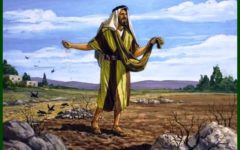
In this lesson, we will set fort the parable of the sower, it's interpretation and application. If we want to follow Jesus, we must obtain and maintain good and honest hearts.
Because the kingdom of God is God’s people, we need to be busy serving God’s people. In my studies, I ran across Proverbs 18:1. The English Standard Version translates it like this: “Whoever isolates himself seeks his own desire; he breaks out against all sound judgment.” Because the kingdom of God is people, we are not to isolate ourselves but be part of the citizenry of the kingdom by participating in its activities. We value God’s kingdom—Christians—by giving ourselves away to others!
So usually when we read about the kingdom in the New Testament, it has reference to the church and vice versa. However, there are a couple of passages where the term kingdom doesn’t refer to the church, but to heaven.
In this sermon we will examine the statement, "To The Blind He Gives Sight." He does this because there is, 1) A Need--the blind need to see, 2) A Name--only He has this authority, 3) A Notion--the blind who see will tell others, 4) A Nation--the blind who see will believe and worship together, and 5) A Night--an eternal blindness is coming for those who do not see. I want to impress upon each hearer that God wants all men to be saved and to come to the truth and to help the congregation become more evangelistic.
Jesus is King of my life (1 Timothy 6:13-16) because 1) He Is My God, 2) He Is My Savior, 3) He Is My All. Each person should be able to state why Jesus is their King.
Daniel 7:1-14 predicts God's kingdom: 1) The Vision, 2) The Unveiling, 3) The Meaning. Each person should understand its history and the coming of the Messiah's kingdom.
"The kingdom of heaven is at hand" (Matthew 4:17): 1) Its Meaning to First-Century Jews, 2) Jesus' Meaning, 3) Its Meaning Today. Each person should apply it to life.
The text of Jesus' parable of the workers in the vineyard, where the landowner pays those hired last the same wage as the first. So the last will be first.
To hunger and thirst for righteousness (Matthew 5:6) is 1) A Desire, 2) Its Object, 3) Its Satisfaction. Each person should know what it means to be filled.
Heaven is like the Grand Canyon (John 14:1-3): it's grand, there's no cheap way across, the way is narrow, and you must go to the water. Each person should know the way.
How to be evangelistic (Matthew 4:19): 1) Let People See Our Life, 2) Talk About Jesus, 3) Invite Others to Hear, 4) Pray. Each person should use these four ways.
Christians seek a kingdom that cannot be shaken (Hebrews 12:28), not an earthly one. Do we invest our love of fatherland in our eternal home (Hebrews 13:14)?
The decision of attendance (Hebrews 10:19-28) should be 1) Subservient, 2) Sustained, 3) Spiritual. Each person should be encouraged toward regular, faithful attendance.