
Assurance of Salvation
Podcast: Play in new window | Download
Subscribe: RSS
Click to expand the full transcript of “Assurance of Salvation”
Well, thank you very much for the opportunity to be with you today, and thank you for the privilege of bringing the lesson. I know Brother Kevin was kind and gracious to allow me to have this privilege, and I thank him as well. You’re a wonderful congregation, and may the Lord bless you in the year that is beginning. I’d like for each of us to ask ourselves two questions. One is rather general in nature, and the other is more specific. The first one is, what kind of assurance of salvation does God give his children?
Number two, can I know that I am forgiven, living in Christ and bound for heaven? It is true that there are several passages in the New Testament that address both of these questions. But there is one in particular that I want to bring before you. Romans 16, 25 through 27. This is at the end of the book of Romans. It would be the last three verses of the book of Romans. 25, 26, and 27. Paul is engaging in praising God. And he utters this doxology, Now unto him who is able to establish you, according to my gospel and the preaching of Jesus Christ, according to the revelation of the mystery which has been kept secret for long ages past, but now is manifested, and by the scriptures of the prophets, according to the commandment of the eternal God, has been made known to all the nations, leading to obedience of faith.
To the only wise God, through Jesus Christ, be glory forever. Amen. You will notice that this is a doxology. A doxology is a bursting forth in praise, adoration, and exultation of God the Father, God the Son, and God the Spirit. In this case, God the Father and God the Son are specifically mentioned, whereas God the Spirit is implied.
Paul has placed this doxology at the very end of the book of Romans. As you know, the book of Romans is the greatest book that has ever been written about our salvation. The way our Bibles are divided up, the book of Romans has 16 chapters. In the first 11 chapters, Paul is stressing the nature of salvation.
In the remaining five chapters, from chapter 12 down through chapter 16, he is emphasizing the necessary application to life of this salvation. Perhaps it would be good for us to picture this doxology in terms of a bookshelf, in a bookcase. And on this shelf there are five items. There would be two bookends and the bookends are made of solid gold. On each bookend there is inscribed a praise of God. The first bookend has on it, now unto him who is able to establish you. Then on the second bookend there would be the praise to the only wise God through Jesus Christ be glory forever. Amen. In between those two bookends there are two books. They’re large books. They’re ornate. They are beautiful. And on the spine of each book there will be inscribed in letters of gold the title of each book. The first book has as its title The Assurance of Salvation-God’s Grace. The second book has as its title The Assurance of Salvation-God’s Integrity. The third book has as its title The Assurance of Salvation-God’s Way. As we stand before these three books, we realize that the six greatest truths of Christianity are before our eyes. God, God’s Son, God’s Spirit, God’s grace, God’s integrity, God’s way. And you will notice as we look at this book, this doxology, that it comes right at the end of the book of Romans. Paul has been dealing with all of the different aspects of our salvation, and it looks like he is just full of praise whenever he comes down to the end of the study, that he just bursts forth in this doxology. And you probably have noticed, as I read it to you, that the word according is used three times in the doxology. Each time the word is used, it is expressing some aspect, some level, some characteristic of this assurance of salvation that we have. Now, it is true that Paul is going to talk about the assurance of salvation that we have sort of indirectly, but he’s really going to lay before us the foundations of the assurance that you and I have that we are actually saved. The first time that the word is used, the word according is used, it points to God’s grace. He begins the doxology by saying, Now unto him who is able to establish you according to my gospel and the preaching of Jesus Christ. The two phrases according to my gospel and the preaching of Jesus Christ can be summarized in one word, grace. You will notice the first word that Paul uses that is very significant to us, would be the word established. Now unto him who is able to establish you. How does God establish us? The word established means to embed us in. It means to connect us to this salvation securely. How does God do that? An illustration would be on the day of Pentecost, whenever Peter preached, the multitude cried out saying, what shall we do?
And Peter said to them, Because you believe, you are to repent, and let every one of you be baptized in the name of Jesus Christ for the forgiveness of your sins, and you will receive the gift of the Holy Spirit.
Luke records, Then they that gladly received his word were baptized, and there were added unto them that day about three thousand souls. What did God do on this occasion? God, through their obedience to the gospel, established them according to the gospel, according to the preaching of Jesus. He made them a part of this gospel. He made them a part of this salvation. He sort of brought them into it and embedded them in it. He established them in it. What kind of gospel did Paul preach? He said, God has established you according to my gospel. What kind of gospel was it? First of all, it was a gospel that had the truth in it about sin. In Romans 3, Paul announces, We have before proved both Jew and Gentile under sin. In Paul’s day, if you were not a Jew, you were a Gentile.
So Paul’s words would be tantamount to his saying, We have before proved the whole world under sin. And his wording is, They are under sin. All of the world, all of the people of the world are under the power of sin, under the guilt of sin, under the condemnation of sin.
Therefore, Paul can conclude in verse 10, 9 and 10, there is none righteous, no, not one. There are no exceptions to this rule. Anybody who is accountable before God is under the guilt of sin. And as such, he is lost. Thus Paul says, the gospel that I’m preaching is a gospel for sinners and sinners only. If you’re not a sinner, you don’t need this gospel. But if you are a sinner, this is the gospel for you. And remember, Paul is going to remind us of the fact that we are dealing with sin in two ways.
It has a past effect to us, and it has a present effect to us. He says, all have sinned, that’s the past tense, and are falling short of the glory of God, that’s the present tense. He’s got the past tense and the present tense in one sentence. He goes back to the past and then he also comes into the present. That’s the news about sin. We’re all guilty. We’re all in need of salvation. But secondly, this gospel that Paul preached had within it the truth about our Savior. In Romans 3, 25, Paul pictures Jesus as the popitiation for our sins.
It’s one of those big words. It’s hard to spell, hard to pronounce. In fact, if you’re like me, I have to get a run at it to actually say it. Popitiation. The New American Standard translation, I believe, has translated it, our atoning sacrifice. That’s helpful to me. But remember the word propitiation. It’s found only about three times in the New Testament. It means the appeasing of God’s wrath. They came to Jesus to crucify him, and he yielded to them. And they took him to the cross, and they nailed him to it. But you know what our Lord did? He took that cross and turned it into an altar. And on that altar, he offered himself as the appeasement for our sin. God is a holy God. He’s a righteous God. He cannot wink at any sin that we’ve ever committed.
He cannot overlook any sin that we have committed. And consequently, a price would have to be paid. For God to remain a just God and justify sinners, a price would have to be paid for that sin. And Jesus offered himself as the appeasement before God for our sins.
And God accepted his eternal sacrifice that he has made and was able, as a result of that, to provide salvation for us. Number three, then, the gospel that Paul preached had within it the truth about salvation. Remember that whenever God saves a man, he does that completely. Whenever God forgives a man, he will forgive him completely. That is, he does not leave out any sin. He forgives every sin. He forgives us completely. And then number two, he forgives us eternally. Whenever God forgives, our sins are completely removed forever. You’ll never need to talk about them anymore. You’ll never need to pray about them anymore. They are completely removed. But Paul will use another word as he describes this salvation. It is the word justification. And you will notice in verse 26, he refers to God in two ways in the same verse.
He is just and he is a justifier. How can that be? The only way that can be is for Jesus to pay the price for our sins. And when we come to Jesus with an obedient faith, Jesus takes our place.
And God is able to justify us, forgive us, completely justify us due to what Jesus has done for us. Now remember, God does not justify anybody in degrees. He does not forgive anybody in degrees. He will not forgive a few of my sins today, a few of my sins tomorrow, a few of my sins the third day. And whenever God justifies me, he does not almost justify me or just halfway justify me.
He completely justifies me. That is, I stand in his sight, totally cleansed of sin, as a just person. As a person in one sense who has never sinned because all of my sins have been removed. Years ago, R.L. Whiteside used this illustration. He said there are only two ways that a handkerchief can be clean. It can be clean, number one, if you’ve never gotten it dirty. Or it can be clean, number two, if even though you got it dirty, you washed it. And then he made this application. He said there are only two ways that a person can be a just person. He can be just, number one, if he has never sinned. But who of us can make such a claim? Number two, he can be just if God has cleansed him. If God has justified him.
And Paul says, we have been justified freely through the redemption that is found in Christ Jesus. It’s a gift. God has given us the gift of justification. Then, Paul draws a conclusion. In Romans chapter 5, verses 1 and 2, he draws a big conclusion. He says, Therefore, having been justified by faith, we have peace with God through our Lord Jesus Christ. This is legal peace. We’re no longer under the wrath of God. We’re no longer condemned. There is, therefore, no condemnation to those who are in Christ Jesus. But have you read the second verse, verse 2? Through whom also we have obtained our introduction by faith into this grace.
Whenever we became Christians through the death of Jesus, we were introduced to the grace of God. And Paul says, in that grace we stand. Now, it would be that phrase that I would want to implant in your mind. Standing in God’s grace. I’m introduced to it. And I enter it whenever I become a Christian. And then I stand in it. Or to say it another way. To say it the way we would say in Arkansas. We’re living in it. We’re living in it. We’re living in that grace. Now the Apostle John said something similar to this in 1 John 1.7. When he said, if we walk in the light. Paul talks about standing. But John talks about walking. If we walk in the light, as He is in the light, we have fellowship one with the other, and the blood of Jesus Christ, His Son, cleanses us from all sin.
It is a present tense that’s used here. We are being constantly cleansed by the blood of Jesus. Why? Because we’re standing in God’s grace. Now, that doesn’t mean we don’t have to apologize for the mistakes we made or make.
You remember in 1 John 1, verse 7, John tells us that we are constantly being cleansed. And then in verses 9 and 10, he says, If we confess our sins, He will forgive us of our sins. So confessing our sins is part of abiding in the light. It’s part of doing the will of God day by day. But the point is that we are standing in God’s grace. And that means that we are constantly kept clean. We are constantly being cleansed by the blood of Jesus. I have a friend who lives over in Oklahoma City. And he almost was in that tornado that came through and destroyed the smaller city of Moore. But he managed to miss it. It moved. It went another direction and consequently didn’t get their house. But he said, I learned a vital lesson.
I decided that I was going to build a safe room in our house. And he told me all about it. He told me how thick the walls were. He told me about the flow of air that they would have whenever they were sort of tucked away in that place.
He told me about the door that he had made out of total metal and it had about four or five locks on it. I mean, he really had a safe room. And he said from time to time whenever we get the report that there is a tornado near or there’s a bad storm coming through, We run into our safe room and lock the door. But I know of a better safe room. It’s not a room that you just run into from time to time. But it’s a room that you live in. It’s sort of like this building. You’re inside it. It protects you from the outside. It protects you from the cold air on the outside. It protects you from any storm that might come through. If you could think of God’s grace that way. It’s all around you as you live in Christ.
And it protects you. It protects you from your mistakes as you acknowledge them and as you try to do what’s right, you’re cleansed. And that grace of God keeps you cleansed. It keeps you right with God. Can I really have assurance in salvation? Yes. Yes, you can. Because as you live in Christ Jesus, as you abide in the light, you’re standing, standing in God’s grace. What kind of grace is it?
Is it a grace that is able to cleanse you of all of your sin? Oh, yes. Where sin abounds, God’s grace abounds all the more, Paul says at the end of Romans chapter 5. Secondly, this word according is used in this doxology to point to God’s integrity.
According to the revelation of the mystery which has been kept secret for long ages past, But now is manifested, and by the scriptures of the prophets has been made known to all the nations. Paul brings up the mystery. What is that? Well, sometimes in the New Testament, he uses the word mystery to refer to an aspect of God’s eternal purpose.
But it looks like here in this doxology, he is using the word mystery to refer to God’s entire eternal purpose. Do you realize that God made a promise to us? I call it the big promise. All of God’s promises are important, but there is a big one that he made to us. You know when he made it? He made it before the foundation of the world. Before the world was ever created, he made it. Paul said to Titus in Titus 1-2, In the hope of eternal life, which God, who cannot lie, promised before the world began.
Way back there in eternity past, God made a promise. His promise was that I am going to provide salvation for anybody who abides in Christ. He didn’t pinpoint anybody’s name. He just said, here is the spiritual body of Christ that’s going to exist. And I’m making the promise that I will save anybody who abides in that promise, in that body.
Thus, we begin to think about the faithfulness of God, the integrity of God. It’s a wonderful thought. Paul says it is above time. It stretches from eternity past all the way to eternity future. And you remember that wonderful verse, Ephesians 1, 4, where Paul says, He chose you in Him before the foundation of the world. He didn’t choose you by name, But he chose to save anybody who comes into the body of Christ and abides in that body.
He made that promise before the world was ever created. Before the mountains were ever made. Before the oceans were ever made. God decided that whoever abides in me, in my Son, I will save. It rises above time. Of course it arises beyond time because it is a part of God. God is beyond time. He is from everlasting unto everlasting. And all of the wonderful attributes of His character are above time. They are perfect. They’re not related to time. And one of those attributes of God that is not related to time is His integrity. It’s impossible for God to lie. His integrity is above time. There’s not anything that’s ever going to happen that’s going to change God’s integrity. Let’s say the mountains melt and flow into the sea. That’s not going to change God’s integrity. Let’s say that the seas break loose and pass the boundaries and cover the earth with water.
That’s not going to change God’s integrity. Let’s say that there is some kind of disease that runs rampant across the earth and three-fourths of the people on earth die. That’s not going to change God’s integrity. God’s integrity will not change. It’s above time. But secondly, it’s absolute. All of the traits of God’s character are absolute. We’ve never met anybody who has absolute integrity. I’ve met some really good people, and it just seems like their integrity is absolute, but it’s really not.
God’s integrity is absolute. It will never change. And there is absolutely no way that God could ever be unfaithful to us. Some time ago, about a year ago, after class, one of my students, a young lady came up to me and I could tell by looking into her face she had something really heavily weighing on her mind.
She said, I want to talk to you privately for a moment. And I said, okay. I looked around. My classroom still had students in it. So we went over to an empty classroom and sat down. And she said, I’m going to have to have an operation, and that operation is scheduled for tomorrow. We don’t know the outcome of it. We don’t know what they’re going to find. It has an exploratory aspect to it. And she said, I’ve never had an operation like this before. I’m having it now because I’ll be able to recuperate from it during the Thanksgiving holidays, and I don’t think I’ll miss a lot of school. But she said, I wanted to sit down with you and ask you for a word of comfort. What are you going to tell a young lady like that?
In that split second, I thought of the faithfulness of God. And I said, I want you to remember this. As they rolled you into the operating room, you tell yourself, there’s absolutely no way that God can be unfaithful to me. He promised me that He would never desert me. And there’s no way that God can fail to keep that promise. You are in the hands of a God who is absolutely faithful.
Thirdly, God wants you to know this. And this truth is accented in the New Testament. Over in Hebrews chapter 6, the writer is emphasizing the faithfulness of God. He starts with Abraham telling about this wonderful salvation that God has provided for us. And then he comes on down and begins to think in terms of human activities.
He says, here’s a man who wants to make a promise. And so he calls in two other men who will be witnesses to what he says. And he makes that promise before them. If somebody ever called him into question, all he would have to do is call in the two men who were witnesses of his promise.
But the writer says, God doesn’t have anybody like that. He doesn’t have two men he can call in. And so you know what God did? He took an oath. He took an oath on his own name. Well, why did he do that? He didn’t need to. Whenever God speaks, that word that he has spoken is absolute in integrity. Why would he need to take an oath? He took that oath for you and me. He wanted us to know beyond any shadow of a doubt that I’m going to keep the promise that I’ve made to you. And so the writer says, There are two, to use the King James translation, immutable things upon which our salvation rests.
Two immutable things. My New American Standard translation has changed the wording from immutable to unchangeable. Two unchangeable things upon which my salvation rests. What are they? Number one, God’s word. He’s never going to break it. Number one is His Word. Number two, His oath. His oath. He took an oath to accent His integrity. And Paul says it would be on that integrity that you and I stand. This hope we have. So that by two unchangeable things in which it is impossible for God to lie, we who have taken refuge would have strong encouragement to take hold of the hope set before us. Notice how the word hope is used. Hope is not about wishing. Hope is not about saying in your heart, well, maybe, almost. Hope is about recognizing it’s just a matter of time. This is true.
It’s just a matter of time. The prophets of old would use the prophetic present. That is, they would utter a prophecy in the present tense. It was as if the prophecy had already been fulfilled. That’s the idea. God’s Word, God’s prophecies are so reliable that it’s as if they’ve already happened. It’s as if they’ve already occurred. If you stand on the promises of God, you can’t stand on a safer place. The most powerful thing on earth is the faithfulness of God. And you might say the most powerful thing in heaven would be the faithfulness of God. Can I be assured of my salvation? Yes, you can because you are surrounded by God’s grace. The most wonderful thing there is. More powerful than any sin that you’ve ever committed. Grace that’s going to sustain you. Grace that’s going to keep you.
And you are also surrounded by the integrity of God. The most powerful thing on earth that there is. And the most powerful thing in heaven that there is. As you think about the future, remember it’s in His hands and you dwell in Him. And He is absolutely faithful. There is no possible way that God can fail you. Thirdly, this word is used as it points to God’s way. According to the commandment of the eternal God has been made known to all the nations, leading to obedience of faith.
That’s God’s way, the obedience of faith. And whenever you think about the book of Romans, he has that phrase in Romans 1, 5, Romans 1, 4, and 5. Then he has that phrase again at the end of Romans. This would be Romans 16, 26. How’s God going to save me? Is he going to save me by me perfectly keeping the law of Moses? No. Is he going to save me by me perfectly keeping the commands of God? No. He’s going to save me by the obedience of faith. That is, God is asking me to believe and to yield to his will.
I’m not going to be perfect at it. But if I’m walking by faith, if I’m yielding, I’m living by the obedience of faith. That’s God’s way. God knows that I’m not going to be able to be faultless. But he knows also that I can be blameless. If I will walk in Jesus, abiding in his word. You know that faith has obedience in it. You know that from this phrase that Paul is using. But as you sort of run through the book of Romans, you will notice that obedience is the general term.
And then underneath that, there will be some specific terms. And here is one of them found in Romans 2, 4. Repentance. Do you not know that the goodness of God leads you to repentance? Part of the obedience of faith would be repenting. Now, we’re not talking about perfection here. We’re talking about yielding to the will of God. Making an about faith saying from here on I will give myself to doing the will of God.
Recognizing that I’m not going to be saved by my perfection. But I’m going to be saved by faith. A faith that pursues. A faith that seeks to obey. That’s repentance. And it’s a part of faith. Confession is a part of faith too. Paul says in Romans 10.10. With the heart, man believes unto righteousness. And with the mouth, confession is made unto salvation. Faith has confession in it. Faith has repentance in it. And when we come to Romans chapter 6, we discover that it’s got baptism in it. Paul says, no you’re not, that those who have been baptized into Jesus Christ were baptized into his death.
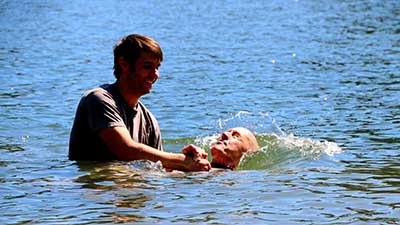
Baptism is an act of faith. It is that moment in time whenever I by faith am baptized into Jesus and baptized into His death. I am covered in His blood and I am forgiven of all sin. Therefore, we are buried with Him by baptism into death. It’s that moment too whenever I am baptized into my own death that like as Christ was raised up from the dead by the glory of the Father, even so we also rise to walk in newness of life. You just can’t miss that. Well, that’s how I get into Christ. That’s how I get into salvation. I get into salvation, into Christ through the obedience of faith. But how do I abide in Christ? You yield. You yield. This is a very important part of Romans chapter 6. How do I abide in Christ through yielding?
The old King James translation used the word yielding. I like it. But my New American Standard translation has presenting. You present your body, your hands, your lips, your eyes, your feet to doing the will of God. You just yield. You yield to Him. I’m not going to be able to do it perfectly. But I’m going to yield. And I’m going to spend my time, my life, enjoying doing His will. And that’s what Paul says. Therefore do not let sin reign in your mortal body. This is how you abide in Christ. So that you may obey its lusts. And do not go on presenting, King James has yielding, the members of your body to sin as instruments of unrighteousness, but present, King James has yield yourselves to God as those alive from the dead and your members as instruments of righteousness to God.
For sin shall not be master over you, for you are not under law, but under grace. You have the opportunity now to yield to God, Resting assured that you’re going to be saved by His grace. You’re going to be walking by faith. But your hands, your mind, your lips, your eyes, your feet will be instruments of doing the will of God in the world. It’s a wonderful thought. Charles Hodge says that every Christian should preach the gospel to himself every morning before he gets out of bed. Hello, self. You know who you are? You’re a Christian, a Christian, a follower of Christ. You know you’ve been saved by God’s grace because you have faith. And it’s obedient faith. You’re abiding in Christ. You are redeemed. You are justified. Now get out of this bed and go out there into the world and yield to the will of God.
You have the wonderful privilege of putting flesh on the will of God before people as you live today. We had a wonderful teacher who taught at Harding for a number of years. You may recognize his name. His name was L.V. Pfeiffer. I got to teach side by side with him for a few years. Back in the fall, though L.V. Had been retired for a few years, L.V. Died.
And the family chose to give his library to us, to truth for a day. And we got not only his books, but we also got his papers. And it was sort of moving to take those papers and put them in the file cabinets where we could easily get to them. And as I was working on this, I came across just a little index card. Apparently, he had used it in a devotional or maybe in his meditations. But I read it. It touched me. He said, If in repentance I must correct all my faults, then I must come to God perfect. But I can’t be without sin or error. But I can be sorry for my sins and commit myself to God turning from sin, turning from an obvious road of sin toward God. Sounds like we’re reading from Romans chapter 6 where Paul says, Yield, yield.
That’s what you can do. That’s what you ought to do. That’s what you have the privilege of doing. You’re not going to yield perfectly. But you will be in God’s grace. You will be living in God’s grace. Can I have the assurance of salvation? Oh, yes. Wonderful thought. Because as I abide in Christ, I’m surrounded by God’s grace. I’m kept saved by God’s grace. I’m justified. I’m redeemed. And not only so, I’m surrounded by God’s integrity. He will never fail me. There’s absolutely no way that He can fail me. And he promised before the world was ever created that he would save people like me who are abiding in Christ. And the devil with all of his power, with all of his might, cannot prevent that. And I’m going about it God’s way. I’m living with an obedient faith.
Will you remember that you cannot have peace unless you have assurance. If you do not have in your heart the assurance that God has given you and you live with it in mind, you can’t have peace. I’m talking about practical peace now. You may have legal peace and not have practical peace. Only way you can have peace is to know assuredly that you are redeemed. And if a tarnate comes through here this very day, blows you away, you’re going to go right straight to the presence of Jesus. Furthermore, if you don’t have peace, you can’t have joy. I’m talking about real joy, real happiness in the Lord. Paul is chained to a soldier 24-7. You talk about freedom. He’s chained to a soldier day in and day out. He said, all right, I’ll take this prison house and turn it into a publishing house.
And while there in that hired house, chained to a soldier, he wrote Ephesians, Philippians, Colossians, and Philemon. And in Philippians, he wrote in chapter 4, Rejoice in the Lord. And again, I say rejoice. You cannot have joy unless you have peace. And you cannot have peace unless you have assurance. And let me tell you something. The sweetest thing on earth is the assurance of salvation. When you have the assurance of salvation, you have peace, you have joy, and you have courage. You have courage to face anything. Devastation, dissolution of the body. The storms that cluster around us. The devil. We have the courage to face anybody. And you remember when they were getting ready to take Stephen out to stone him. God said, look up. And he looked up and he saw Jesus standing on the right hand of God in glory.
As if to say, Stephen, it’s alright. I’m here. I’ll be with you. I want to give you assurance. I want you to know that you can handle it. And out he went. And as the rocks hit his jaws and caved in his arms and caved in his chest, he was praying, Lord Jesus, receive my spirit. I know you’re there. I know where I’m going. And do not lay this sin to their charge. Assurance, peace, joy, and courage. All of this can be yours. And all of this can be mine. And remember, I can know it. I can know it. If you don’t have it, don’t leave this building until you do. We’re going to sing an invitation song. We don’t do this just as a tradition. We’re actually inviting you to do something about your life if you need to.
And there probably are some here who do. You’re coming to God’s grace. You’re coming to God’s integrity. You’re coming God’s way. And as a result, as you begin to live by obedient faith, you will have the sweetest thing known to man, assurance of eternal salvation. If you need to come, come while together we stand and sing.
End of transcript. Thank you for reading along!

Assurance of Salvation: Lesson Notes
Guest speaker Eddie Cloer preaches on the Christian’s assurance of salvation.
See also: The Book of Life